

< Research Reports 22 Oct, 2026
Challenges and Pain Points of Traditional Automatic-Sorting Systems

EXECUTIVE SUMMARY
For over three decades, traditional fixed automatic-sorting systems—such as cross-belt, tilt-tray, and sliding-shoe sorters—have served as the central backbone of mega-hub express logistics. However, rapid shifts in global supply chains, e-commerce volatility, urban land costs, and stringent ESG standards have exposed critical structural flaws in these legacy solutions. High upfront capital investment, extreme custom engineering costs, extended deployment schedules, and operational rigidity have rendered fixed sorting infrastructure increasingly unviable for mid-to-large logistics operators.
1. EXTREMELY HARD TO GREENLIGHT
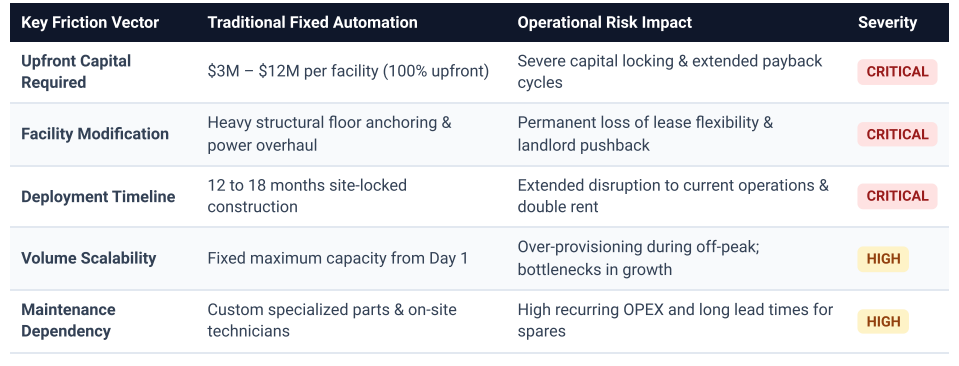
Securing executive C-suite and board approval for a traditional automated sorting system has become an increasingly daunting corporate obstacle. The fundamental barrier lies in the sheer magnitude of non-recoverable, high-risk capital expenditure (CapEx) required upfront. Unlike modular software or fleet-based robotics, traditional sorters represent a permanent, site-bound civil engineering project.
Financial risk is compounded by the high opportunity cost of capital tied up in infrastructure during years-long installation phases. Decision-makers are required to sign off on multi-million dollar investments based on volume forecasts 5 to 10 years into the future. In today’s volatile market environment, this rigid horizon carries unacceptablefinancial exposure.
COMPARATIVE FRICTION SUMMARY: FIXED SORTERS VS. INDUSTRY REQUIREMENTS
2. PAINFULLY LONG DELIVERY CYCLE
The end-to-end journey of implementing a customized legacy sorting system spans from initial feasibility studies to final site acceptance testing (SAT). When accounting for initial pre-sale negotiations, vendor RFP evaluations, and contract finalization, the entire lifecycle frequently stretches to 3–4 years. The execution phase alone takes 12 to 18 months.

High Customization & Certification Overhead: Because legacy steel sorters are designed on a per-facility basis, equipment manufacturers build low-volume, highly variable machine configurations. This lack of standardization leads to steep manufacturing costs per unit. Furthermore, every bespoke electrical panel and motor layout must undergo field-level regulatory approvals (such as FCC and UL certifications in North America or CE mark compliance in Europe), incurring high testing fees and processing delays.
3. DOUBLE RENT & STEEP RELOCATION EXPENSES
Deploying a fixed sorting system inside an active sorting center requires massive floor space cleared for steel assembly, line alignment, and electrical conduit routing. Because logistics operators cannot simply shut down daily operations during the 6-to-8 month physical construction window, they are forced to lease an auxiliary temporary warehouse facility.

4. INFLEXIBLE OVER-PROVISIONING
Fixed automation forces a rigid binary choice: under-build and face system failure during peak seasons (e.g., Black Friday/Cyber Monday), or over-build from Day 1 to support growth anticipated 5 to 7 years later. Consequently, logistics providers are compelled to over-provision.
During 80% of the operating year, large portions of a fixed loop or cross-belt conveyor sit underutilized while still incurring constant power, idle wear, and fixed maintenance overhead. Should volume surpass initial design targets, expanding a physical fixed loop requires major structural retrofits, leading to operational downtime.
5. HEAVY POWER DRAW & GRID UPGRADE ROADBLOCKS
Legacy sorting systems rely on heavy 480V AC high-voltage industrial power supplies to drive central motorized loops, heavy pneumatic pushers, and extensive induction belts. Peak electrical demand can quickly saturate standard industrial building allowances.

6. SINGLE POINT OF FAILURE & HIGH MAINTENANCE COSTS
Traditional linear and loop sorters are fundamentally single-point-of-failure (SPOF) systems. Because power delivery, communications, and drive belts are linked sequentially, a single mechanical jam, broken chain link, or blown main controller halts the entire facility.
Daily operation requires dedicated on-site engineering maintenance teams available across all shifts. In the event of a catastrophic drive failure, sortation halts completely, creating massive downstream parcel backlogs and missed delivery SLAs.
7. HIGH NOISE LEVELS & SEVERE WORKER COMP LIABILITY
Operating traditional steel-on-steel sorters, high-speed rollers, and pneumatic divert mechanisms produces continuous ambient noise levels between 85 dB and 90 dB.
These noise profiles trigger strict OSHA (Occupational Safety and Health Administration) compliance guidelines,necessitating mandatory hearing conservation programs, protective equipment, and regular audiometric testing. Legacy urban hubs operated by major parcel carriers face millions of dollars in annual worker compensation claims and escalating insurance premiums tied to long-term occupational hearing loss.
8. OVERLY COMPLEX MAINTENANCE & FRAGMENTED FOOTPRINT
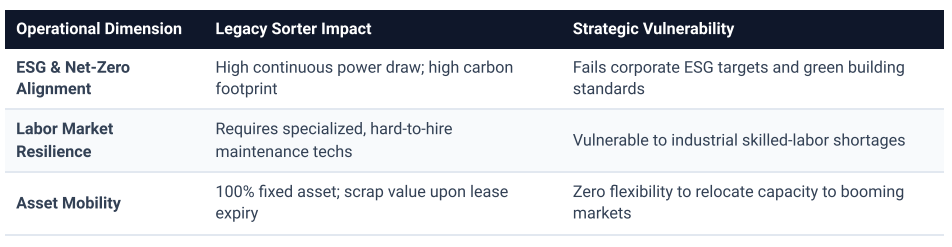
Due to custom engineering, legacy sorters rely on a fragmented footprint of specialized spare parts—custom-wound motors, proprietary divert shoes, non-standard sensor brackets, and specialized drive cards. Maintaining thesesystems requires highly trained industrial mechanics and automation technicians who command premium wages.
OPERATIONAL IMPACT BREAKDOWN
Keep reading
Download the PDF version
Please fill in your information to download. Fields marked * are required.


Copyright @ GHE SOLUTION INC. All Rights Reserved