

< Research Reports 22 Oct, 2026
Predictive Analysis of Data Sources for Future Physics SI
Please note that this article is an original work by GHE Solution. When citing formulas and figures from this article, please attribute the source.
1. Current AI Data Sources and Their Limitations
Modern Artificial Intelligence, particularly Large Language Models (LLMs), has achieved remarkable breakthroughs in text generation, semantic comprehension, and static vision tasks. However, these models rely predominantly on internet-scale text and two-dimensional static image datasets. This foundational architecture inherently limits their applicability in physical environments due to two critical flaws:
• Absence of Native Spatial and Temporal Concepts: LLMs process tokens sequentially without a grounded, continuous understanding of 3D physical space or absolute time dynamics. They learn correlations between symbols rather than physical laws like momentum, gravity, or friction.
• Inability to Directly Act Upon the Physical World: Current generative models are purely cognitive entities. They operate within a digital “sandbox,” producing output without direct physical feedback loops, spatial embodiment, or real-time actuation capabilities.
To evolve toward physical spatial intelligence (Physics SI), AI must transition from passive internet text interpretation to active, real-time embodiment.
2. Predictive Analysis of Data Sources for Future Physical SI
To evolve from current AI to Super Intelligence (SI), the core path lies not in merely stacking compute power, but first in perceiving the physical world, and secondly in acting upon it. Crucially, microsecond-level data synchronization between actuators and sensors serves as the critical cornerstone for future SI to act on the physical world. It will also be the fundamental infrastructure that enables SI to rapidly evolve beyond human intelligence and drive breakthroughs in scientific research.
As Artificial Intelligence transitions from purely cognitive understanding to physical interaction, the composition of training and operational data sources will shift fundamentally.
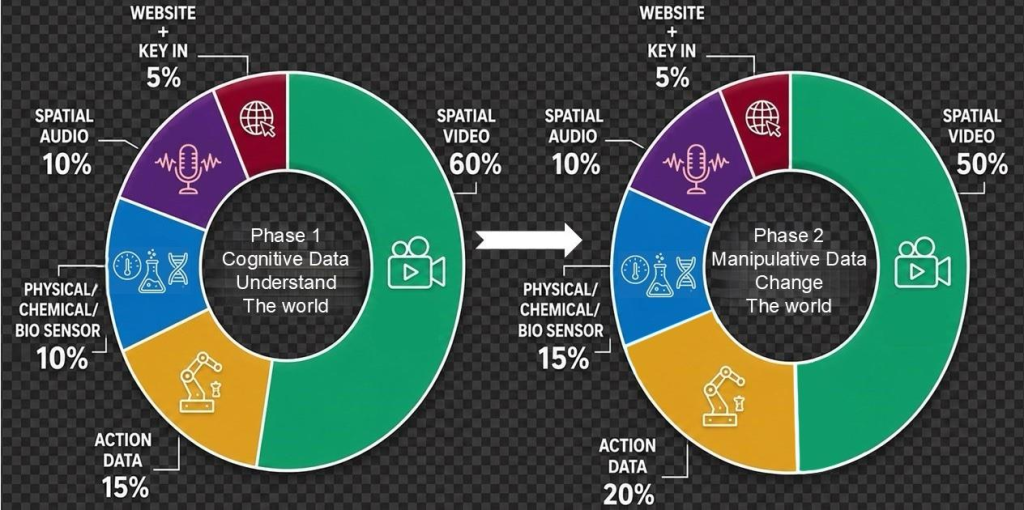
Phase 1: Cognitive Data — Understanding the World
In this initial stage, the goal is to establish passive spatial awareness and comprehensive world modeling:
• Spatial Video (60%): Serves as the backbone for multi-view visual dynamics, scene reconstruction, and depth understanding.
• Action Data (15%): Captures preliminary kinetic observations and motor trajectories.
• Physical/Chemical/Bio Sensors (10%) & Spatial Audio (10%): Provide foundational contextual feedback beyond sight (e.g., tactile pressure, ambient acoustics, temperature).
• Website + Key in Data (5%): Retains symbolic grounding and higher-level textual/command alignment.
Phase 2: Manipulative Data — Changing the World
In the active manipulation phase, the system shifts focus from observing the environment to physically altering it:
• Action Data (increases to 20%): Directly grows to support fine motor control, grasping, force-torque control, and dynamic manipulation tasks.
• Physical/Chemical/Bio Sensors (increases to 15%): Expands to provide dense closed-loop feedback required during physical contact and complex material interactions.
• Spatial Video (adjusts to 50%): Remains the primary perception modality but gives up relative share to accommodate active physical interaction channels.
3. The Critical Importance of Microsecond-Level Synchronization Between Sensors and Actuators
Achieving Physical SI requires precise real-time synchronization between sensory inputs and physical output action, down to the microsecond level.
1. Real-Time Perception of the Physical World: Physical phenomena (such as high-speed collisions, vibration dynamics, or fluid flows) occur continuously. Microsecond perception ensures the system captures transient dynamic behavior without jitter, phase lag, or motion blur artifacts.
2. Real-Time Actuation in the Physical World: Feedback loops in high-dynamic manipulation (e.g., high-speed robotic assembly, precise force control) require immediate actuation response. Millisecond delays can cause catastrophic resonance, mechanical instability, or over-torque.
3. Foundation for True World Models (Beyond Simulation): Pure simulation models (Sim2Real) fail due to the “reality gap”—unmodeled physical nuances like friction hysteresis, thermal drift, and vibration. Microsecond-synchronized sensor-actuator data streams provide the deterministic real-world ground truth required to construct and validate scalable World Models.
4. Implementation Method for Microsecond Synchronization: Single–SoC Integrated Architecture
Traditional multi-chip systems separate sensor acquisition (Sensor Hubs) and actuator control across distinct microcontrollers/processors connected via standard external communication buses (e.g., CAN, SPI, Ethernet). This introduces asynchronous bus latencies, clock drift, and jitter that ruin microsecond synchronization.
If an integrated design relies on discrete sensors and components, the resulting latency increases significantly, making it difficult to acquire real-time data from various sensors during actuation. Such execution delays introduce substantial errors into the world model, potentially leading to complete inaccuracy.
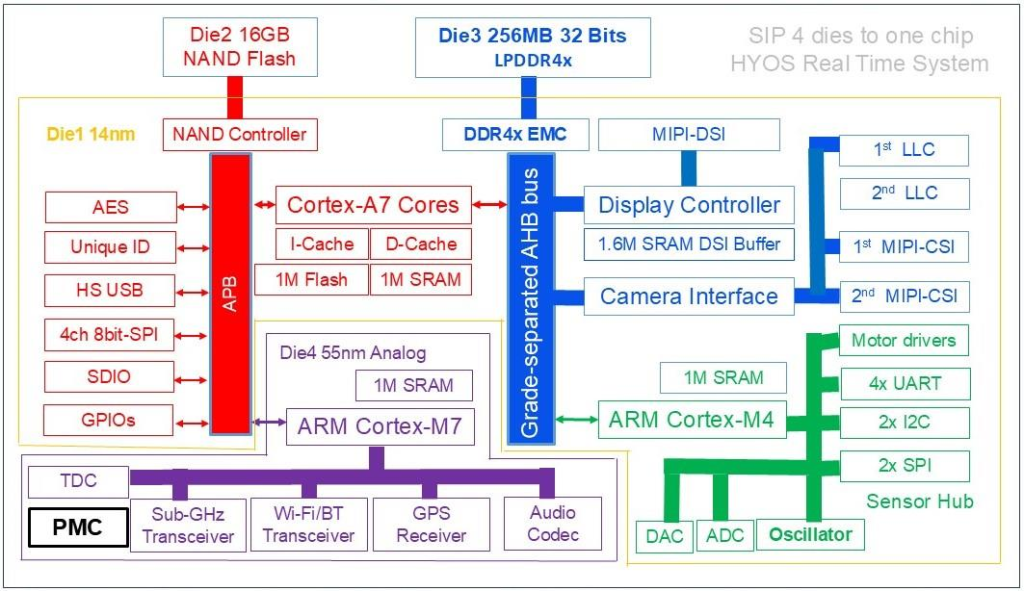
Architectural Key Elements (Based on System Design):
• Unified Clock Tree & Single Clock Source: As shown in the System-in-Package (SiP) architecture, the primary differentiator is that the real-time processing engine (e.g., ARM Cortex-M4 sensor hub/actuation block) shares a unified internal clock tree driven by a single integrated Oscillator.
• Integrated Concurrent Data & Control Paths: The SoC concurrently routes incoming high-bandwidth sensor pipelines (MIPI-CSI camera interfaces, ADC feeds, audio codecs) and outgoing actuator control signals (Motor drivers, DACs, GPIOs) on a single die/package connected viaultra-low-latency internal buses (such as grade-separated AHB buses).
• Elimination of Phase Drift: Because both acquisition and execution blocks share the same crystal clock domain and real-time core execution (Cortex-M4), timestamp alignment happens directly in hardware with Time-to-Digital Converters (TDC) and PMC logic, completely eliminating inter-chip signal propagation delays and guaranteeing deterministic, microsecond-level synchronicity.
5. Summary
The transition of AI from digital cognition to physical Super Intelligence (SI) relies on a fundamental shift toward real-time spatial, bio-sensor, and action data rather than merely scaling compute power.
Achieving true physical interaction requires microsecond-level synchronization between perception and actuation. By leveraging unified single-SoC architectures with a shared clock tree, future physical SI systems can bridge the gap between simulation and reality, laying a deterministic foundation for embodied world models and accelerated scientific discovery.
Keep reading
Download the PDF version
Please fill in your information to download. Fields marked * are required.


Copyright @ GHE SOLUTION INC. All Rights Reserved