

PCD: Package Call Driver
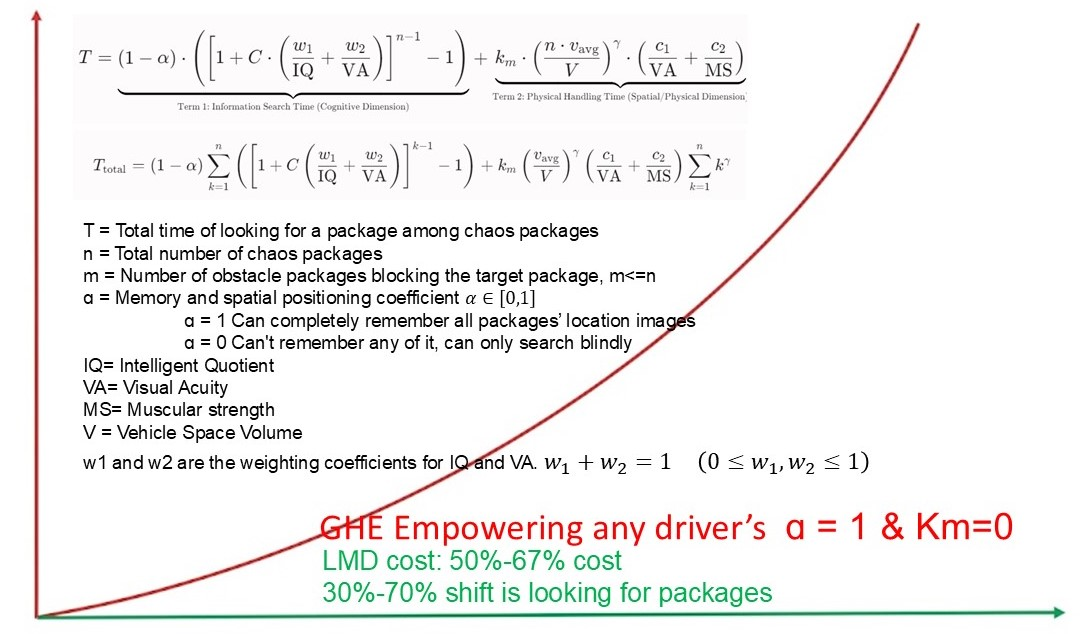
The search time curve for LMD drivers looking for a package inside a vehicle when packages are in a chaotic state: when the quantity exceeds 300 pieces, the total search time can exceed 24 hours. This explains why two traditional solutions exist to control search time:
- The UPS/FedEx model: Packages are loaded into vehicles by sector and organized in sequence.
- The Amazon model: Packages are loaded into a dozen totes, leaving only about 20 packages per tote.
According to our research, both traditional models have their own advantages and disadvantages, but the proportion of wasted time remains roughly the same. The formula shown applies not only to locating packages inside LMD vehicles, but also to finding items in any disordered environment.
What is GHE doing?
GHE’s revolutionary innovations and patents focus on helping all drivers achieve α = 1 and Km = 0, which means helping drivers eliminate all actions related to searching for packages. The time spent searching for packages is reduced to almost zero at all times, regardless of the number of packages or whether they are arranged in an ordered or disordered state.
GHE’s PCD Patented Solution and 100+ real-world field tests introduce a completely new paradigm: Embracing Information Entropy. Instead of forcing order before the driver leaves the station, we let smart technology handle the chaos in real time.
In contrast, traditional LMD solutions (including Amazon’s tote mode and UPS’s sector mode) have always fought against information entropy—spending endless time and effort meticulously organizing, sorting, and sequencing packages. All of these actions are meant to make it more convenient for drivers to search for packages, but they do not align with First Principles.
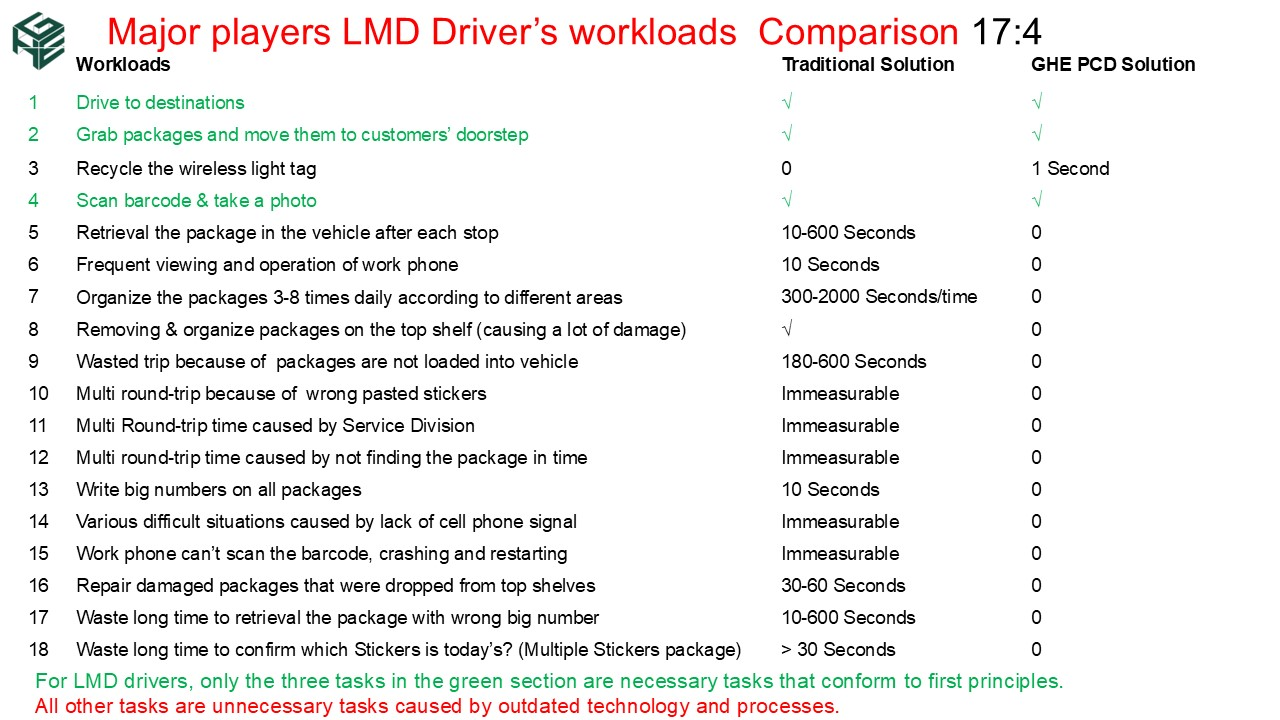
Only 3 actions truly align with First Principles
- Driving to the customer’s destination
- Grabbing the package and moving it to the customer’s doorstep
- Scanning the package barcode and taking a photo as proof of delivery
LMD Drivers’ Time Distribution of US. Major Players (High stop density)
Driver Time Distribution – Flat City (Plains)
Driver Time Distribution – Mountain City
Data Source: GHE On-Site Process Research & Field Data (300+ Field Audits)
- Direct Operational Experience: 6+ months of hands-on driving experience across Amazon, UPS, and FedEx.
- Empirical Research: Comprehensive on-site observation, driver interviews, and statistical analysis across major carriers.
- Key Insight: Identified package searching as a systemic “learned helplessness” efficiency bottleneck in last-mile logistics.
In the UPS/FedEx delivery mode, where packages are loaded into vans by sector without physical space constraints, the packages inside the vehicles quickly become chaotic—especially in hilly or mountainous cities. Even when using EVs powered by Indigo’s smart wheels technology, the packages will still inevitably turn into chaos.
Normalization factors for packages becoming chaotic
| Factor | Flat City | Mountain City |
|---|---|---|
| Crest Vertical Curve (Crown) | - | 10.0 |
| Sharp Turns | - | 9.0 |
| Steep Grade | - | 6.0 |
| Emergency braking | 3.0 | 5.0 |
| Quick lane change | 3.0 | 5.0 |
| Hump | 3.0 | 5.0 |
| Reversing | 2.0 | 2.0 |
| Search through the packages | 1.0 | 1.0 |
The table above shows why delivering in mountainous regions leads to a higher proportion of time spent searching for packages, both directly and indirectly. Packages become chaotic much faster on mountain routes, forcing drivers to reorganize them more frequently during the day to avoid severe search delays upon parking.
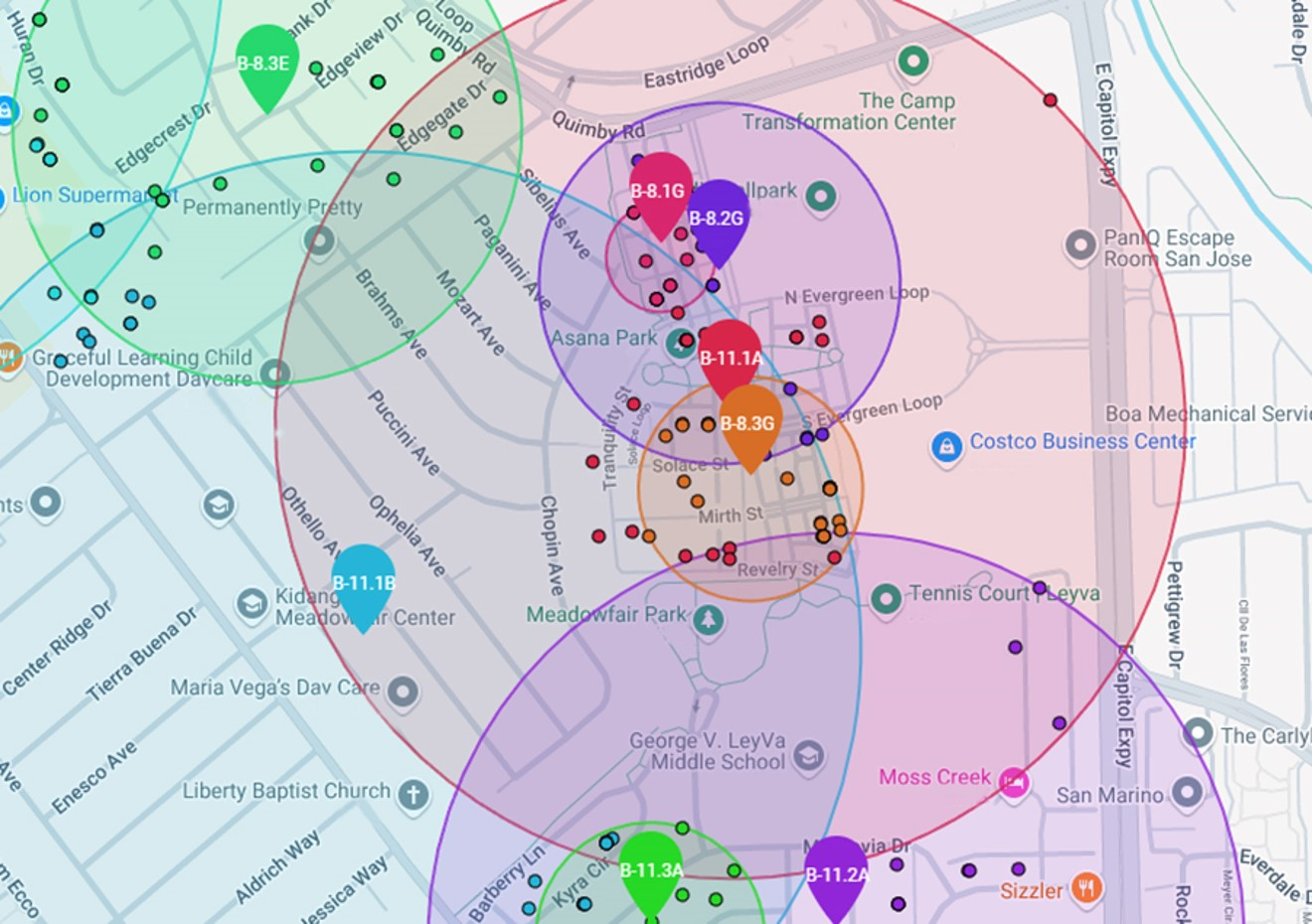
Amazon’s Tote mode can slow down the growth of information entropy, but it leads to more multi-round trips. This happens because packages intended for the same destination are sometimes sorted into different totes. In the worst case from my own experience working as a last-mile delivery driver, I had to drive to the same address 4 times in a single day.
In the diagram below, each circle represents a tote, and each small dot inside represents a package. As the distribution illustrates, Amazon’s tote-based model—designed to limit entropy growth—inevitably results in numerous multi-round trips.
“Search time” isn’t just a driver looking for a package in the van. It also includes:
- Pre-loader sorting efforts: 70% of pre-loaders’ time is spent trying to load packages in order
- Mid-route cargo reorganization
- Checking the delivery app 10+ times per package
- Writing large stop numbers on boxes
- Backtracking when a package cannot be found in time
- Opening, folding, and returning totes
All the non-first-principles workarounds above stem from one core failure: package search inefficiency.
Please note that only 3 actions of LMD drivers meet the First Principles:
- Drive to the destination
- Grab the packages and move them to the customer’s doorstep
- Scan the package barcode and take a photo as delivery confirmation
Key Game-Changers of GHE PCD Solution
Perfectly aligning with First Principles, leaving drivers with only 3 essential actions:
- Random Loading: Zero pre-sorting or FILO (First-In-Last-Out) hassle at the station. Just load and go.
- Auto-Flashing Smart Tags: When the driver parks, the target package’s tag automatically flashes (as demonstrated in our real-world van test). Drivers simply grab and go—no searching, no manual sorting, and no constant app checking.
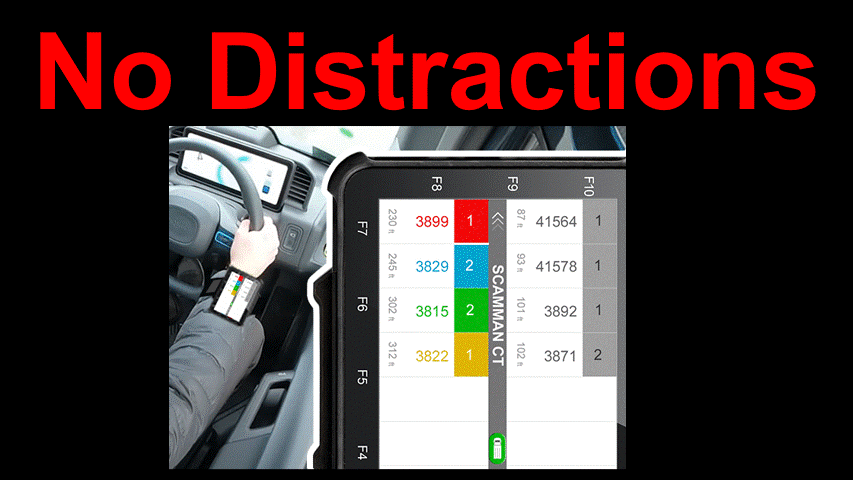
- Ultra-Simple & Safe Driver UX: A distraction-free app designed to keep drivers focused and safe on the road.
- Unmatched Efficiency: 2x faster in flat cities and 3x faster in mountainous terrain.
- Built-in Security: Real-time anti-theft and anti-loss alert systems.
PCD Hardware Topology
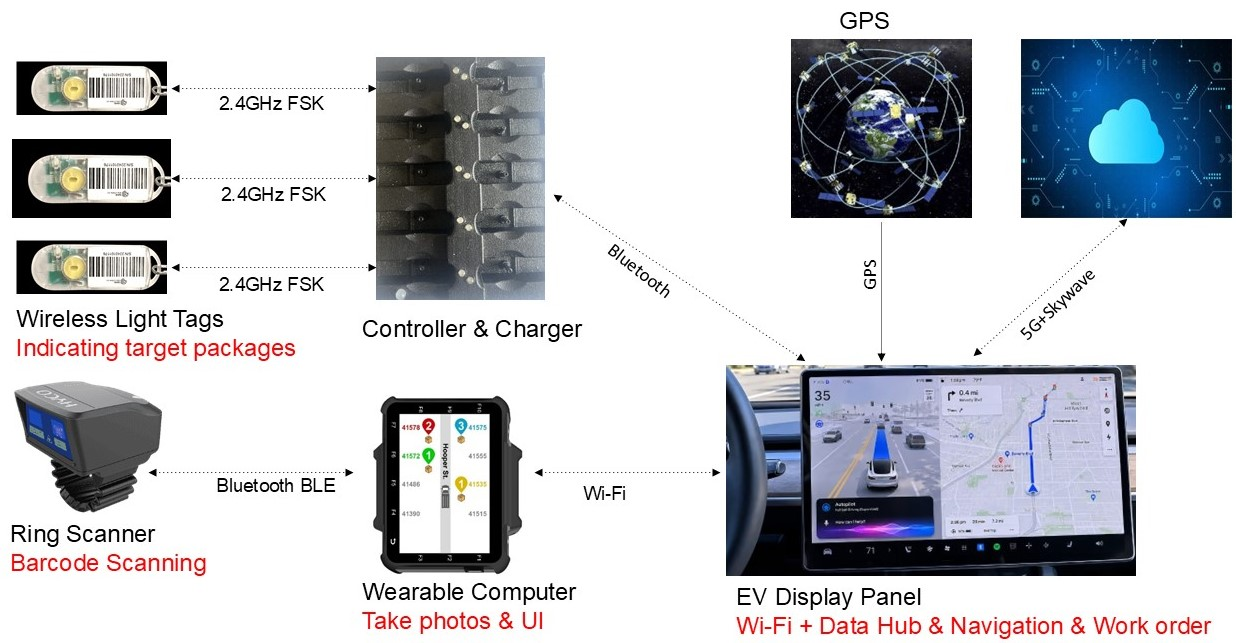
GHE’s PCD solution consists of four hardware components: wireless light tags, a specialized controller and charger, a ring scanner, and a wearable computer, along with an APK embedded with GHE’s patented PCD algorithm.
Performance
- Maximum Tag Quantity: 2048
- Response Time: 1 Second
- Robust Communication: Private encryption algorithm and retransmission mechanism
- Flash Indicator Colors: Red, Green, Blue, Yellow, Pink, White
Benefits
- Random Loading: Load packages randomly into the vehicle at the delivery station with no pre-sorting or FILO required.
- Auto-Flashing Target Tags: The target package’s tag automatically flashes upon parking, directing the driver to grab it directly—no package searching, no cargo organizing, and no constant app checking.
- Ultra-Simple Delivery App: Safe, distraction-free driving.
- Unmatched Efficiency: 2x efficiency in flat cities, 3x efficiency in mountain cities.
- Built-in Security: Anti-theft and anti-loss alarm system.
On-site Testing
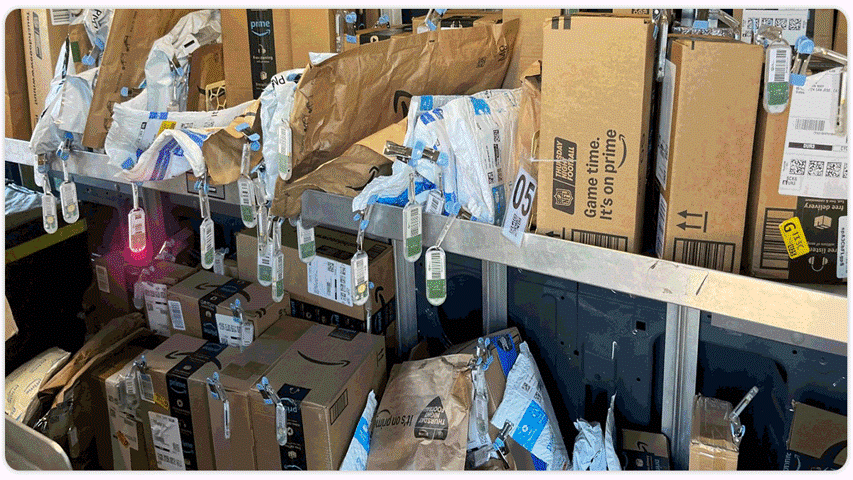
More than 100 on-site tests demonstrate its proven effectiveness:
- 2x Efficiency in Flat Cities
- 3x Efficiency in Mountain Cities
The perfect turn-key solution for LMD is GHE PCD + GHE DCD + Indigo EV:
- 3x Efficiency in Flat Cities
- 5x Efficiency in Mountain Cities
Road Map of GHE Wireless Light Sticker

L302 1.2 mm Ultra-Thin Light Sticker
- Eco-Friendly & Wireless: Recyclable and wirelessly rechargeable
- Core Functions: Package Call Sorter & Package Call Driver
- Zero Mistakes: Automatic checkout across all processes
- Triple Efficiency: 3x efficiency across the entire process
- Built-in Security: Anti-theft and anti-loss alert features
- Automated Deployment: Can be automatically applied at delivery stations
- Customizable Performance: Adjustable communication distance and transmission rate
SMAS: Snap Modular Auto-Sorting System
Pain points of traditional automatic sorting systems
- Extremely Hard to Greenlight: Massive up-front investments carry high risk due to expensive field relocations, loud operations noise, huge power consumption (making electrical grid upgrades near-impossible), and lengthy installation timelines.
- Painfully Long Delivery Cycles: Project execution takes 12–18 months covering site surveys, engineering design, reviews, simulations, customized manufacturing, on-site installation, and commissioning. Factoring in pre-sale negotiations, the entire journey often drags out to 3–4 years. Customization also leads to high FCC & UL certification costs and long processing times.
- Double Rent & Steep Relocation Expenses: To keep existing operations running during the 6–8 months deployment phase, logistics companies must rent a second facility. Overlapping lease payments plus physical relocation costs usually run between $1M and $2M.
- Inflexible Over-Provisioning: Systems must be overbuilt from day one to accommodate future volume growth. Without massive redundant capacity, fixed automation quickly becomes a bottleneck as business grows.
- Heavy Power Draw & Grid Upgrade Roadblocks: High energy consumption and 480V AC high-voltage demand create major ESG/Net-Zero hurdles. In the US and Europe, utility power upgrades cost hundreds of thousands of dollars, require 12–15 months for approval, and need explicit landlord permission—a major roadblock for small-to-midsize logistics providers and local carrier hubs.
- Single Point of Failure & High Maintenance Costs: Installation requires certified specialized engineering teams, and daily upkeep demands dedicated on-site technicians. Because power and control systems are centralized, a main drive or controller failure can paralyze the entire system for hours—or days.
- High Noise Levels & Severe Worker Comp Liability: Operating noise routinely hits 85–90 dB, triggering expensive OSHA compliance and hearing protection mandates. Legacy urban hubs (like those operated by FedEx and UPS) face massive annual payouts for worker compensation claims and skyrocketing insurance premiums tied to occupational hearing loss.
- Overly Complex Maintenance: Custom engineering leads to a fragmented footprint of highly specialized parts and equipment. Keeping them running requires complex technical skill sets and drives up ongoing maintenance costs.
New ideas of GHE Snap Modular Auto-Sorting System
1. Standardized Modular Architecture: only 4 core building blocks
The entire system relies strictly on four standard modular units regardless of facility size, exit count, or throughput capacity:
- A-Cell: Belt conveyor
- B-Cell: Swivel wheel diverter
- C-Cell: Multifunctional scanning gantry
- D-Cell: Exit chute
Infinite Scalability: Systems are rapidly configured using formulaic combinations of k C-Cells, n A-Cells, m B-Cells, and 2m D-Cells. k, n, m stand for the quantity of each cell.
2. Industry-Leading Energy Efficiency: ultra-low power consumption
- A-Cell: only 13% power consumption of a traditional belt conveyor
- B-Cell: only 25% power consumption of a traditional swivel wheel sorter
- C-Cell: only 25% power consumption of a traditional multi-function tunnel scanner, with dynamic idle power management for A-Cells & B-Cells
Total system power consumption is under 20% of traditional sorting systems, enabling deployment in standard warehouses without utility capacity requests.
3. Tool-Free, Rapid Field Deployment
- Lightweight Construction: Built with high-strength 5083 aluminum-magnesium alloy. Every cell module weighs under 70 lbs. (31.5 kg), enabling tool-free manual handling by a single worker.
- Tool-Free Height Adjustments: Segmented support columns (25–35 cm units) thread together by hand to easily adjust line height, supported by dual-locking casters with 10 cm fine-tuning.
- Foldable Chutes: D-Cells feature 3-segment butt-hinge designs for fast folding, transport, and rapid site setup.
4. All-in-One Multifunctional Sensing (C-Cell)
OCR all label information; Dimensioning; Weighing
5. Plug-and-Play Intelligent Control (A-Cell & B-Cell)
- Global Unique IDs: 32-bit unique ID for each cell. Upon boot, the system auto-discovers and self-organizes its topology without manual layout.
- Ring Bus Reliability: Built-in anti-interference RS-485 ring topology ensures continuous operation even if a single connection breaks.
- Scalable Bus Power: Small setups run on a single power supply; larger loops simply drop in additional modules (1 power unit per 8–12 cells).
6. Enhanced Safety, Low Noise & OSHA Compliance
- Safe 24V DC Operation: Low-voltage DC powering across drive modules ensures safe installation and maintenance.
- Ultra-Quiet Operation: 60–65 dB acoustics footprint instead of traditional 85–90 dB, comfortably exceeding OSHA hearing protection standards.
7. Ergonomics & Zero-Injury Design
Chamfered edges eliminate sharp corners, dramatically reducing workplace contact injuries and liability claims.
Key Advantages of GHE Snap Modular Auto-Sorting System
1. Zero Operational Downtime (In-Situ Deployment)
- Seamless In-Place Retrofit: Save the $1M–$2M cost of relocating to a new facility.
- Zero Revenue Loss: No relocating to a new facility.
2. Ultra-Fast Rapid Deployment (2–3 Day Go-Live)
- Toolless Assembly: Field assembly from months to days.
- Minimal On-Site Integration: Plug & Play.
3. Modular Scalability & Phased Capex (Pay-As-You-Grow)
- Incremental Automation Scaling: Deploy automation in modular stages aligned with actual daily volume growth
- Transition manual to full automation over time rather than day-one capital expenditure
- Dynamic Layout Flexibility: Reconfigured, Expanded, or relocated overnight
4. Maximized Field Reliability & Serviceability
- Hot-Swappable Components: Snap-in, toolless architecture.
- Self-Healing Diagnostics: Unique board IDs combined with powerline telemetry provide pinpoint.
5. Ultra-Low Power
20% of the power consumption of traditional automated sorting systems.
6. Ultra-Quiet Operation
- 60-65 dB Acoustic Footprint, instead of traditional solution’s 85 dB – 90 dB
- Worker Retention & Ergonomics
7. Save Operation Cost
- Save annually $500K Electricity bill (@240K Daily PCS)
- Save Labor Cost, Save Recruiting & Retaining cost
- Save Claims solving cost
- Save Recruiting & Retaining cost
- Reduce customer acquisition costs by standard service
3D Modeling pictures of GHE Snap Modular Auto-Sorting System
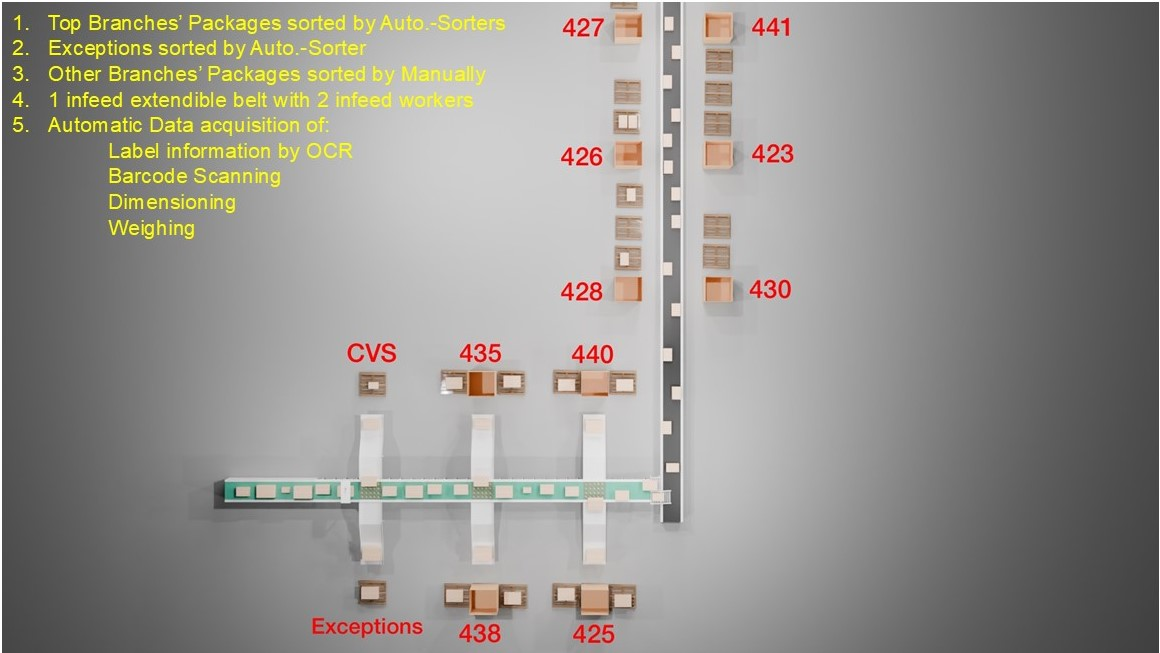
Daily processing capacity: 60K PCS
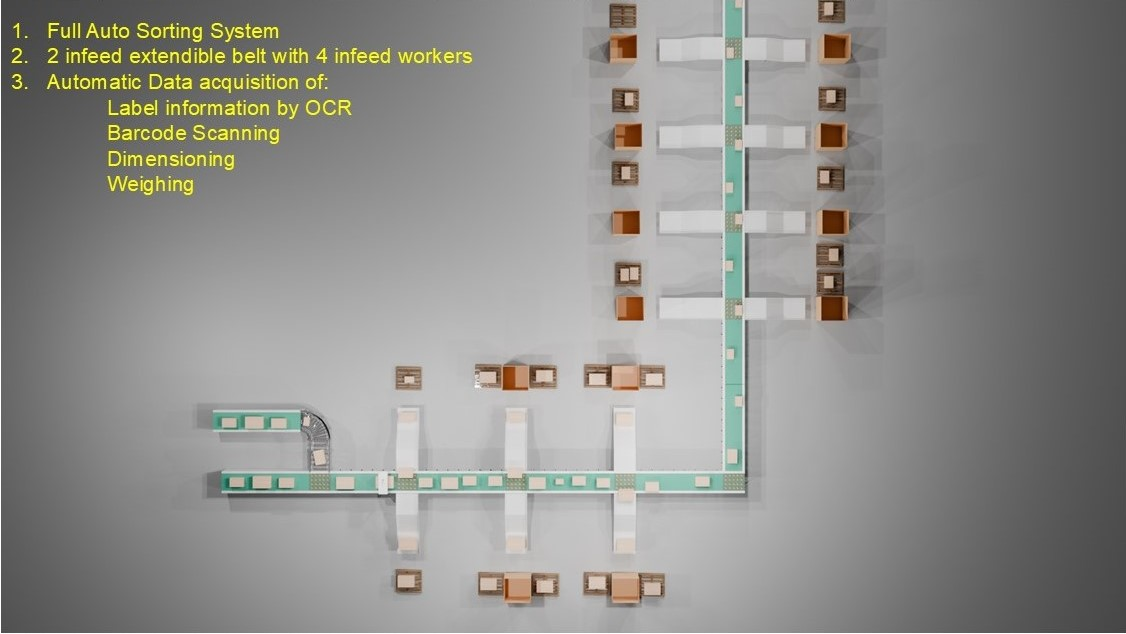
Daily processing capacity: 120K PCS
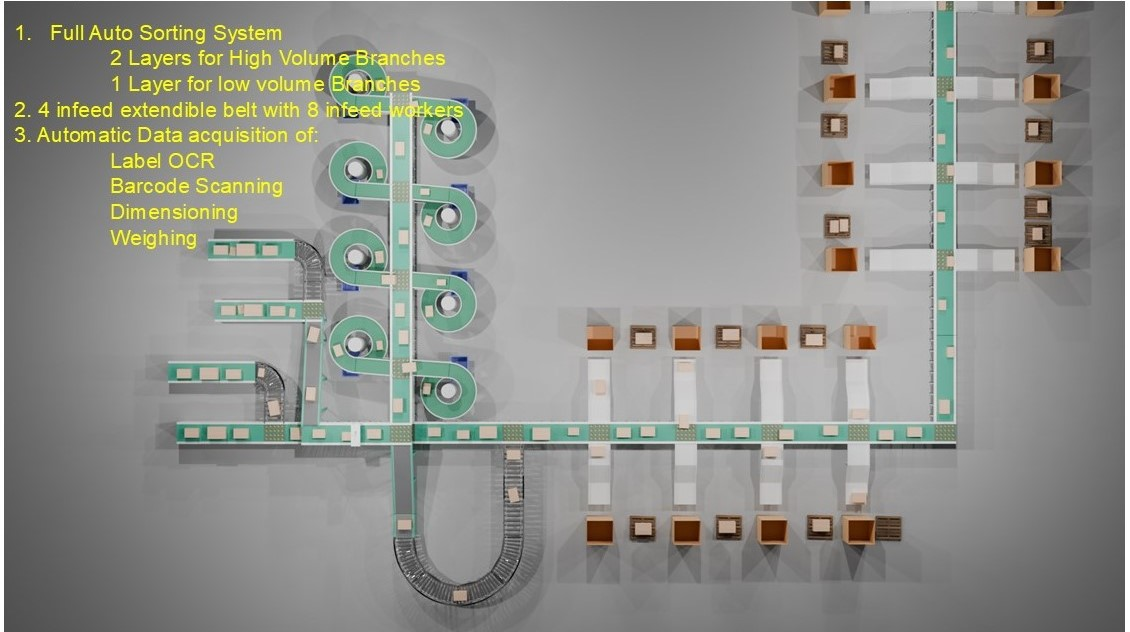
Daily processing capacity: 240K PCS
SNP: Laser Stop Number Printer
Core Advantages
High-Speed Execution
Ultra-fast automated printing of large stop numbers.
Instantaneous Marking
Completes print cycles in just 50 ms per stop number.
Universal Compatibility
Works seamlessly across all types of thermal labels.
Extended Throw Distance
Dynamic printing capabilities at a distance of 20 to 80 cm.
Maintenance
Zero consumables required & zero maintenance.
Weight
12 lbs.
Size
1feet X 1feet X 0.6 feet
Printing Speed
1 Number: 20mS
2 Numbers: 40mS
3 Numbers: 60mS
2 Numbers: 40mS
3 Numbers: 60mS
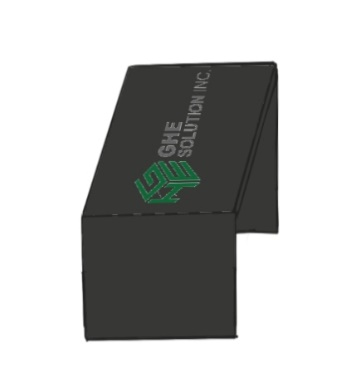
Applications
- Help LMD drivers auto-print the stop numbers in delivery stations (non-PCD users)
- Automatic serial number printer for manufacturers
TC8: Whole Process Optimization Advisor
Pain points of traditional time and process diagnostics
- Multiple device requirements: Relies on various tools such as counters, timers, cameras, and laptops.
- Manual data recording: High labor input with susceptible human errors.
- Manual analysis & reporting: Time-consuming data processing and report compilation.
- Complex collaboration: Requires multi-person coordination and teamwork.
- Operational disruption: The evaluation process can easily disturb workers’ normal workflows.
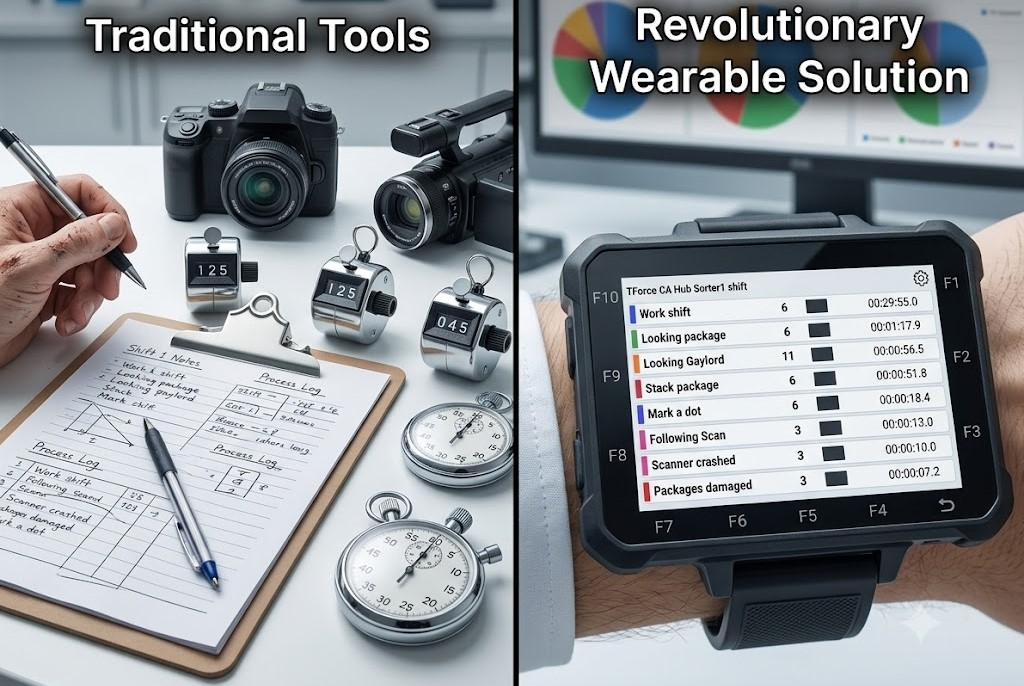
To address these pain points, GHE has integrated its ultra-low-power logistics technology and extensive process optimization expertise to design a dedicated time and process diagnostics APK—powered by our wearable computer and ring scanner.
GHE’s proprietary time and process diagnostic tool (GHE-TC8) features an ultra-simple UI, as shown below:
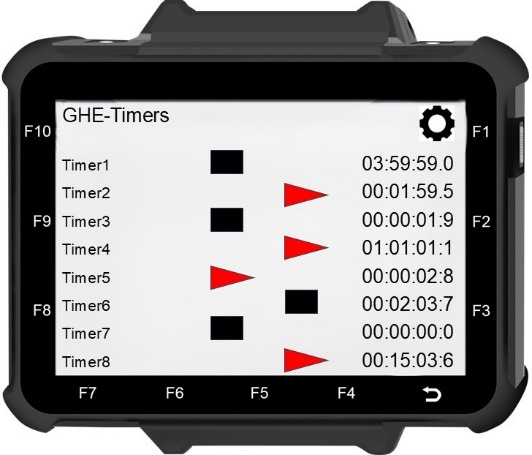
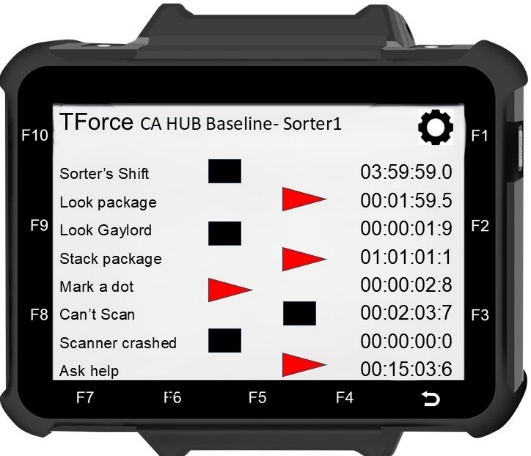
Key Features / Functions
- 8 Counters, 8 Stopwatches & Built-in Camera
- GPS & G-Sensor Integration
- Automatic Data Recording, Statistics & Analysis
- Pie Charts & Exportable Visual Reports
- Camera for On-site Incident/Accident Recording
- Hands-free Wearable Design
- Multiple Trigger Modes: On-screen Icon or Ring Scanner
- Fully Customizable / Renamable Items
- Non-Disruptive Diagnostics: Operates smoothly without interrupting workers’ normal workflow
Why is GHE able to assist carriers in optimizing their overall processes?
- 34 years of experience in ultra-low-power IoT sensors & actuators
- 18 years of R&D in logistics and supply chain technologies
- 18 months of hands-on experience across various frontline roles, such as driver, picker, sorter, packager, and loader
- Co-author and setter of multiple logistics technology and process standards
- Proven expertise in designing automated sorting center architectures that handle tens of millions of parcels daily
- Deep proficiency in logistics technology and end-to-end process optimization
- A strong foundation in management, economics, physiology, and psychology


Copyright @ GHE SOLUTION INC. All Rights Reserved