

< Research Reports 22 Oct, 2026
Breakthrough Strategies for Regional Carriers
Please note that this article is an original work by GHE Solution. When citing formulas and figures from this article, please attribute the source.
1. US. LMD landscape & Pain Points
Fig1 US. LMD landscape & Pain Points
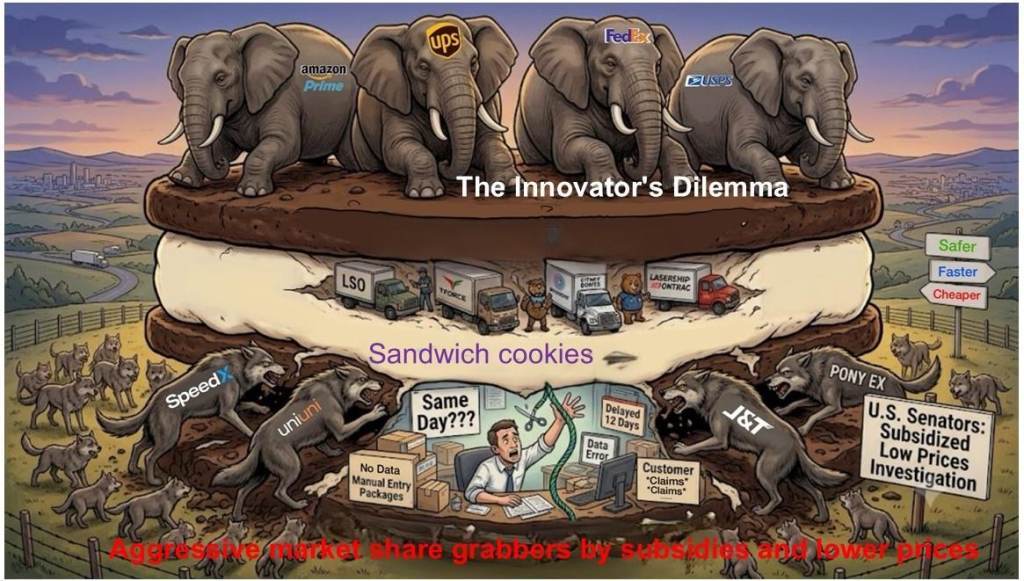
Major Players possess strong brand recognition and comprehensive networks, but lack innovation. Overpriced, slow, and high-loss package delivery services have severely hampered the US real economy. Although these companies dominated the US parcel market for over decades, they have lost approximately 2-3% of their market share in the past year. This shows that US shippers are not solely loyal to the high-priced, slow, and high-loss-rate “white elephant” major players; all shippers expect safer, faster, and cheaper parcel services.
China-Funded LMD Carriers rely on low pricing and aggressive subsidies for rapid growth, appealing to certain shippers while carrying significant policy risks. If these companies can simultaneously offer low prices, speed, and affordability without potential data security and legal compliance risks, it will likely capture a significant market share from Major Players in the coming years. but the US government, guided by market principles, is unlikely to forcibly shut down these Chinese-owned carrier companies in the short term.
Regional Carriers, despite decades of history, lack technological innovation and are increasingly sandwiched between the Major Players and Chinese-funded carriers. Without third-party revolutionary tech innovations and process optimizations, they will struggle to survive under this dual pressure, because of their low stop density, low level of path optimization and sorting automation, these companies have a higher Last Mile Delivery cost ratio and higher customer acquisition cost than Major Players. For decades, they have been able to survive by relying on only a dozen or even just a few shippers. They simply do not have the capital to recruit senior professionals to optimize processes or invest in advanced technologies and equipment, thus being trapped in a vicious cycle of barely making ends meet.
2.Cost Analysis & Cost-Down Strategies of Regional Carriers
Fig2: Major Player’s Cost Composition (High stop density)
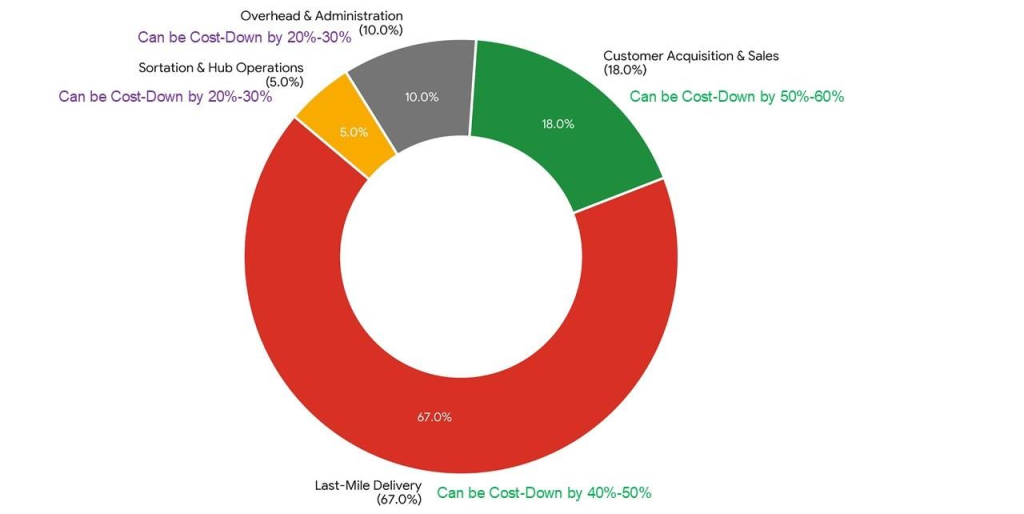
Because regional carriers lack long-haul trunkline transportation and suffer from low stop density, their last-mile delivery accounts for an even higher share of total costs, soaring to as much as 67%. To be sure, as stop density improves, the share of last-mile delivery costs for regional carriers will naturally decline. However, under the traditional delivery model, that cost ratio inevitably hits a hard floor at 50%.
Fig3 Drivers’ Time Distribution of US. Regional Carriers
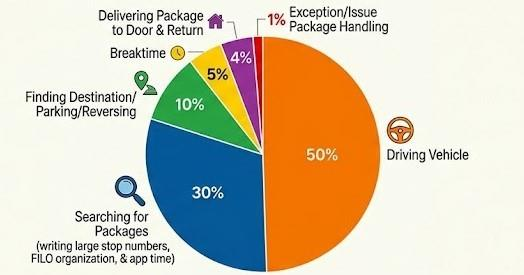
Unlike major players whose primary time sink lies elsewhere, regional carriers suffer from extremely low stop density, forcing drivers to spend up to 50% of their time behind the wheel. In contrast, total time spent searching for packages—both directly and indirectly—accounts for roughly 30%. However, as stop density improves over time, the proportion of time consumed by package retrieval will naturally creep upward.
3.Major Pain Points of Regional Carriers
Low Stop Density: For regional carriers without an in-house packages volume like Amazon or Walmart, building stop density hinges entirely on client acquisition—specifically, securing mid-to-large-scale shippers. Winning these shippers, in turn, relies on two critical factors: maintaining a high SLA performance and offering standardized, transparent pricing mode.
Fragmented and Subpar SLA Standards:The core parameters of an SLA include:
1. Pricing standardization and speed;
2. Delivery rates;
3. Delivery speed;
4. Loss and damage rates.
5. Customer complaint rate and complaint handling speed
Weak Technological Innovation Capabilities:Because regional carriers operate in a traditional industry with razor-thin gross margins, they lack both the capital to attract top talent and the funds to invest in automation and emerging tech. As a result, their overall SLA performance remains subpar, with vast inconsistencies across different branches.
Inadequate Process Optimization and technology innovaton.
High Customer Acquisition Costs (CAC) Driven by Non-Standardized Pricing Models: Onboarding a single client requires asking dozens—or even hundreds—of questions and takes months to close. This stems from a financial catch-22: with razor-thin margins, regional carriers lack the capital to invest in advanced automated equipment and process overhauls. Consequently, they cannot capture accurate parcel dimensions and weights at a low cost, making a standardized pricing strategy virtually impossible. In our discussions with multiple carriers, we found that onboarding a new shipper requires asking dozens—or even hundreds—of tedious questions just to establish a baseline average price. Worse yet, whenever a shipper’s parcel profile shifts in volume or weight, both parties are forced back to the negotiating table. This creates friction for shippers, making it not only extremely difficult for carriers to win new accounts, but also putting existing client relationships at constant risk.
4.Pathways of Divergence for Regional Carriers Over the Next Decade
The Narrow Gate: Breakthrough into the Major Players,A select few regional carriers will successfully elevate themselves into the ranks of major players through revolutionary technological innovation and radical process optimization. Stepping through this narrow gate requires:
• Executive Decision-Making Capability
• Courage to Innovate
• Collaborative Mindset
The False “Wide Gate”: Niche Survival via Extreme Customization,Roughly 10% may barely manage to scrape by offering extreme differentiation and highly customized services. While this appears to be an easier, wider path, it is ultimately an illusion—over-customization is notoriously hard to scale, and trying to withstand competitors delivering top-tier SLA performance is like trying to stop a chariot with a broomstick.
Extinction: The Legacy 90%,The remaining 90%—complacent, risk-averse, and resistant to change—will simply vanish from the market.
5. A Virtuous Cycle for Regional Carriers Requires External
Catalysts—Capital Consolidation Alone Is a Dead End:
Standardized Operations & Dynamic Allocation: Establish uniform shipping label formats, standardized SLA benchmarks, and a centralized national customer service hotline powered by virtual routing. By dynamically allocating regional volumes, carriers can rapidly boost stop density.
Forming the Regional Carriers Alliance (RCA): Unify regional players into a franchise-based national network. By leveraging next-gen paradigms, RCA can effectively function as the New Paradigm Alliance
(NPA) or the Embrace Information Entropy Increase Alliance (EIEIA).
Unlocking Belly-Hold Capacity for Agility: Mobilize commercial belly-hold capacity across the nation through high-frequency, small-batch daily flights. This network model makes next-day delivery nationwide and same-day delivery intrastate a commercial reality.
Fig4 The cycle of SLA & Shippers & Carriers & Tech. innovation
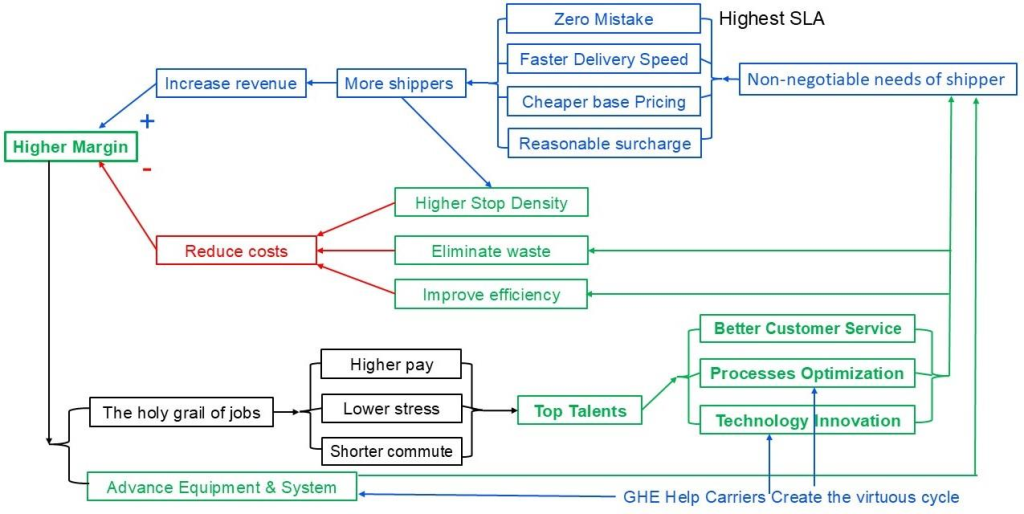
From a shipper’s perspective, the demand for parcel delivery services to be cheaper, faster, and safer is a non-negotiable constant. Under legacy operational paradigms, however, these three needs form a fundamental trade-off that cannot be satisfied simultaneously. This structural conflict is precisely why regional carriers, despite surviving for decades, have consistently struggled to scale and achieve meaningful growth.
GHE’s Strategic Roles:
1. Vendor of Advanced Equipment & Systems
2. Partner in Technological Innovation
3. Advisor & Consultant for Process Optimization
6. Summary
The vision of GHE Solution is to drive first-principles paradigm shifts in technology and process innovation, empowering everyone—from frontline workers to managers—to double their productivity while working safer and with less stress, so they can truly Go Home Early. GHE Solution’s mission is to leverage this new paradigm to help carriers break the traditional trilemma of “safer, faster, and cheaper.”
By embracing GHE Solution’s revolutionary model, forward-thinking regional carriers have the rare opportunity to reinvent themselves, achieve rapid growth, and break into the ranks of major players.
Keep reading
Download the PDF version
Please fill in your information to download. Fields marked * are required.


Copyright @ GHE SOLUTION INC. All Rights Reserved