

< Research Reports 22 Oct, 2026
The research report of US. parcel service industry
Please note that this article is an original work by GHE Solution. When citing formulas and figures from this article, please attribute the source.
1. US. LMD landscape & Pain Points
Fig1 US. LMD landscape & Pain Points
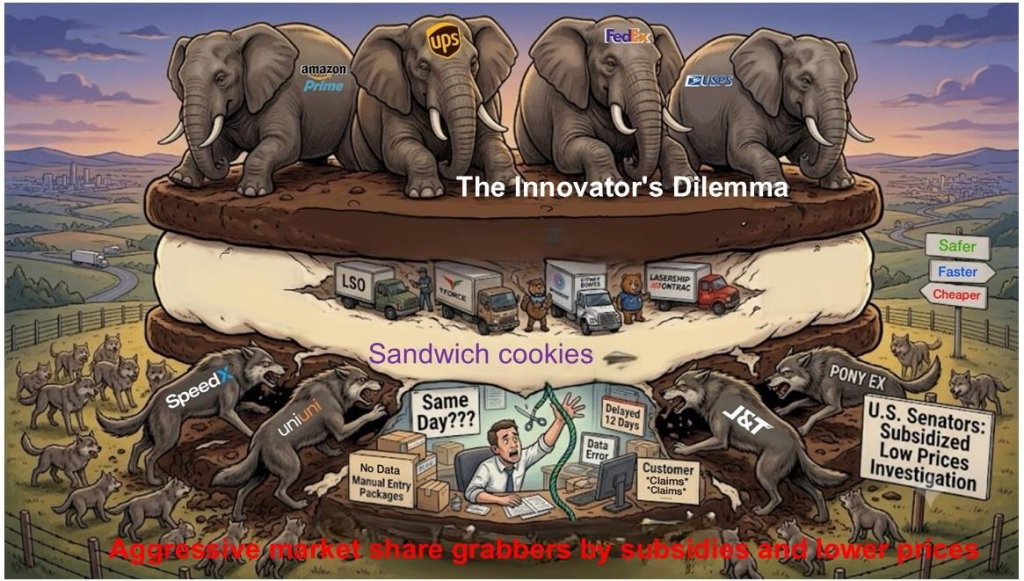
Major Players possess strong brand recognition and comprehensive networks, but lack innovation. Overpriced, slow, and high-loss package delivery services have severely hampered the US real economy. Although these companies dominated the US parcel market for over decades, they have lost approximately 2-3% of their market share in the past year. This shows that US shippers are not solely loyal to the high-priced, slow, and high-loss-rate “white elephant” major players; all shippers expect safer, faster, and cheaper parcel services.
China-Funded LMD Carriers rely on low pricing and aggressive subsidies for rapid growth, appealing to certain shippers while carrying significant policy risks. If these companies can simultaneously offer low prices, speed, and affordability without potential data security and legal compliance risks, it will likely capture a significant market share from Major Players in the coming years. but the US government, guided by market principles, is unlikely to forcibly shut down these Chinese-owned carrier companies in the short term.
Regional Carriers, despite decades of history, lack technological innovation and are increasingly sandwiched between the Major Players and Chinese-funded carriers. Without third-party revolutionary tech innovations and process optimizations, they will struggle to survive under this dual pressure, because of their low stop density, low level of path optimization and sorting automation, these companies have a higher Last Mile Delivery cost ratio and higher customer acquisition cost than Major Players. For decades, they have been able to survive by relying on only a dozen or even just a few shippers. They simply do not have the capital to recruit senior professionals to optimize processes or invest in advanced technologies and equipment, thus being trapped in a vicious cycle of barely making ends meet.
2. The Market Share of US. Package service industry
Fig2:Market Share of US. Packages (2025-2026)
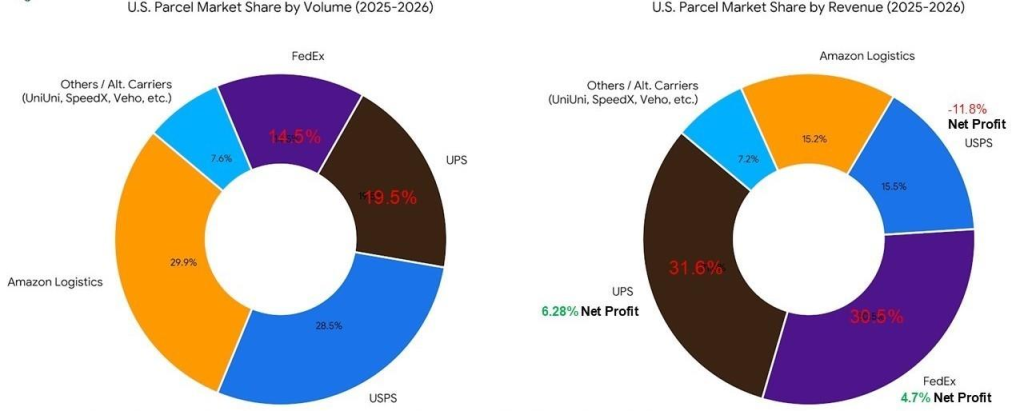
Fig3:Market Share of US. Packages (2015-2016)
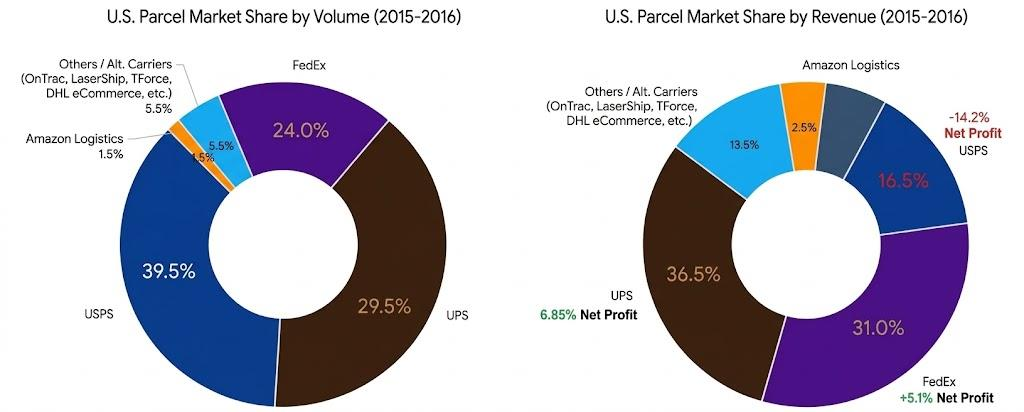
Over the past decade, Amazon has aggressively expanded its market share, surging nearly twentyfold from a modest 1.5% in 2015 to 29.9%. This growth is primarily fueled by the massive volume of its first-party e-commerce orders, where delivery is essentially treated as a fulfillment cost rather than anindependent revenue driver, explaining its relatively low top-line shipping revenue.
While UPS still retains the top spot by revenue, its share of total parcel volume has been in a steadyslide, dropping from 29.5% to 19.5% over the same ten-year period—a staggering 34% loss in market share. Led by a CFO-turned-CEO, UPS pivoted toward high-margin, premium markets while shedding low-margin volume. In a static landscape where technologies, paradigms, and total market sizes remain fixed, this margin-focused strategy would be textbook perfect. However, the U.S. is the epicenter of disruptive, paradigm-shifting innovation. When a new operational paradigm emerges that breaks the traditional “safer, faster, cheaper” trilemma—delivering parcels at lower costs, higher speeds, and with SLA defect rates an order of magnitude better than UPS—the legacy model faces existential risk.
Shackled by Teamster resistance to technology and burdened by the inertia of a 120-year-old organization, UPS risks becoming the “Kodak” of the logistics industry
USPS, on the other hand, managed to trim its net loss margin by 2.4 percentage points over the past decade, though it still operates at an 11.8% loss. If USPS proactively embraces these emerging paradigms, it has a genuine opportunity to turn the tide and finally reach profitability.
3.Cost Composition of US. Major Players
Fig4: Major Player’s Cost Composition (High stop density)
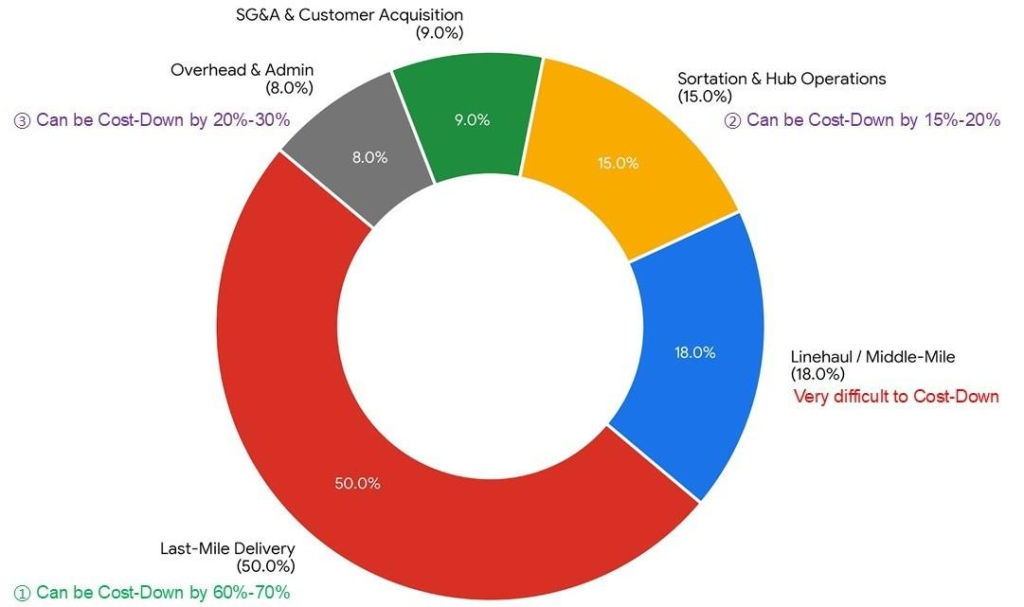
Even for major players with high stop density, last-mile delivery still accounts for roughly 50% of total operating costs. Compounded by chronic driver shortages, rising wages, and escalating fuel prices, the cost burden of last-mile logistics is set to climb even higher.
Fig5 Regional Carriers Cost Composition (Low Stop Density)
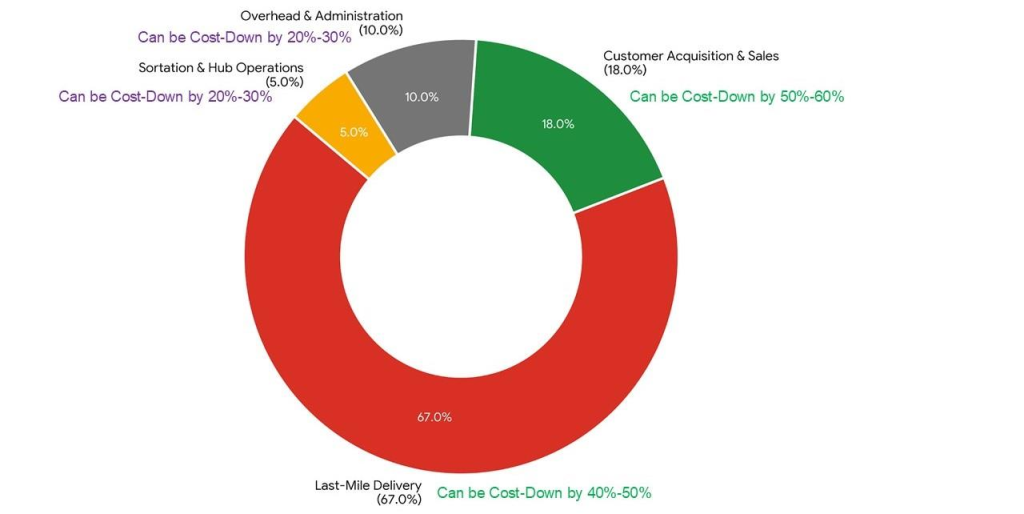
Because regional carriers lack long-haul trunkline transportation and suffer from low stop density, their last-mile delivery accounts for an even higher share of total costs, soaring to as much as 67%. To be sure, as stop density improves, the share of last-mile delivery costs for regional carriers will naturally decline. However, under the traditional delivery model, that cost ratio inevitably hits a hard floor at 50%.
4.LMD Drivers’ Time Distribution of US. Major Players (High stop density)
Fig6 Drivers’ Time Distribution of US. Major Players
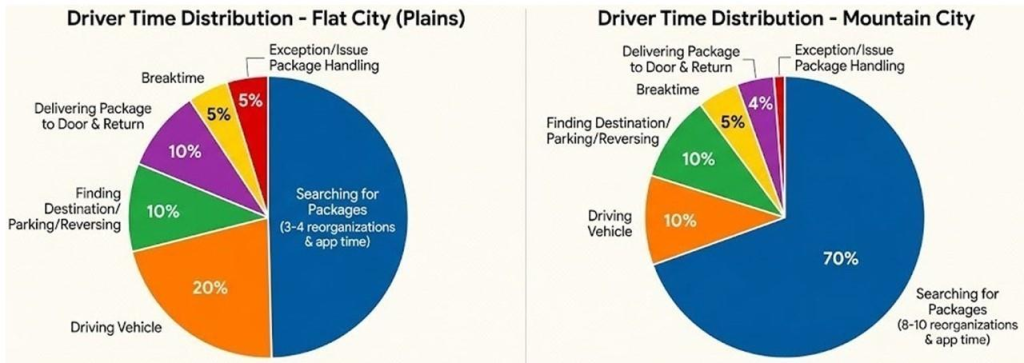
In mountainous cities, drivers spend a significantly higher percentage of their time searching for packages compared to those in flat terrain. Negotiating sharp turns and steep inclines constantly throws organized packages out of order, forcing drivers to organization their parcels far more frequently throughout the day.
Fig7 Drivers’ Time Distribution of US. Regional Carriers
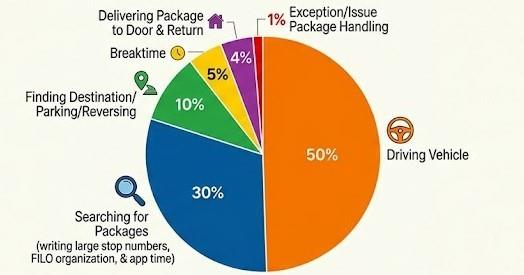
Data Source: GHE On-Site Process Research & Field Data (300+ Field Audits)
1. Direct Operational Experience: 6+ months of hands-on driving experience across Amazon, UPS, and FedEx.
2. Empirical Research: Comprehensive on-site observation, driver interviews, and statistical analysis across major carriers.
3. Key Insight: Identified package searching as a systemic “learned helplessness” efficiency bottleneck in last-mile logistics.
In the UPS/FedEx delivery mode, where packages are loaded into vans by sector without physical space constraints, the packages inside the vehicles quickly become chaotic—especially in hilly or mountainous cities. Even when using EVs powered by Indigo’s smart wheels technology, the packages will still inevitably turn into chaos.
Normalization factors for packages becoming chaotic
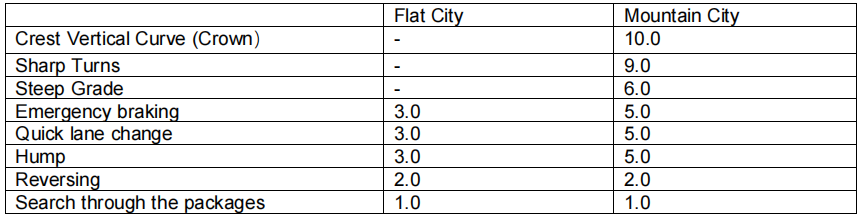
The table above shows why delivering in mountainous regions leads to a higher proportion of time spent searching for packages, both directly and indirectly. Packages become chaotic much faster on mountain routes, forcing drivers to reorganize them more frequently during the day to avoid severe search delays upon parking.
Please note that “Search time” isn’t just about a driver looking for a package in the van. It actually includes:
• Pre-loader sorting efforts: 70% of pre-loaders’ time is spent trying to load packages in order.
• Mid-route cargo reorganization
• Checking the delivery app 10+ times per package
• Writing large stop numbers on boxes
• Backtracking when a package cannot be found in time
• Opening, folding, and returning totes
All the non-first-principles workarounds above stem from one core failure: package search inefficiency.
Please note that only 3 actions of LMD drivers meet the First Principles:
1. Drive to the destination
2. Grab the packages and move them to the customer’s doorstep
3. Scan the package barcode and take a photo as delivery confirmation
5.The Risk & Chance of Major Players
UPS: Shifting toward premium markets is a flawed strategy. In this new era of paradigm shifts, UPS is precariously close to becoming the “Kodak” of the logistics industry.
FedEx: With the founder’s legacy still casting a strong shadow, his son wielding solid influence at the executive level, and the founding family maintaining clout on the board—all paired with far less union drag—FedEx is best positioned to lead the charge in adopting “entropy-embracing” paradigm innovations. They have a real shot at leaving UPS in the dust and crowning themselves the new market king within five years.
USPS: Slowly and painfully introducing external paradigm innovations will give USPS a fighting chance to turn a profit while preserving its universal service mandate. The friction will be immense and progress agonizingly slow, but backed by federal subsidies, it will remain too big to fail.
Amazon Prime: Transforming internal workflows is notoriously tough. However, because Amazon views last-mile delivery strictly as a fulfillment cost, they would gladly welcome any player—be it FedEx or regional carriers like TForce/Ontrac—that leverages paradigm innovation to push last-mile costs far below those of Amazon’s in-house network. Offloading a massive volume of parcels to third parties would allow Amazon to dramatically slash fulfillment expenses while driving down return rates.
6.The breakthrough of Regional Carriers
Squeezed by low-cost aggressive China-Capital based players from below and major legacy giants from above, regional carriers are entering a make-or-break era. The status quo of the past four or five decades—where they simply drifted along, “neither growing nor dying”—is no longer sustainable. They must either reinvent themselves through radical transformation or face extinction.
Fig8 The cycle of SLA & Shippers & Carriers & Tech. innovation
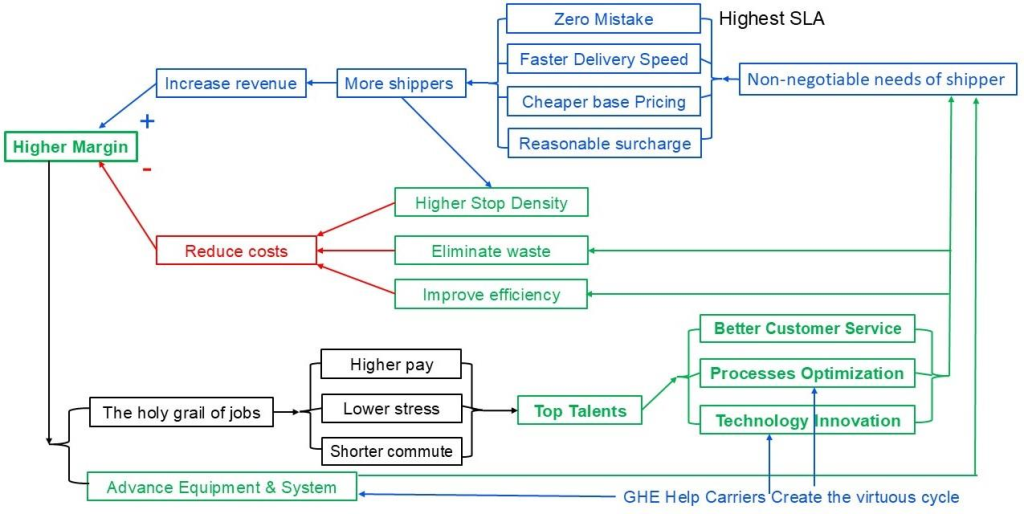
For shippers, faster speeds, lower rates, and bulletproof reliability (zero mistakes) are non-negotiable needs when choosing parcel delivery services. For carriers operating under legacy models, however, balancing “safer, faster, and cheaper” has long been an impossible trilemma.
Operating on razor-thin margins, regional carriers have virtually no headroom for further price cuts and lack the capital to fund proprietary tech innovations or process overhauls. Survival hinges on a select few who can nimbly leverage third-party paradigm shifts—such as GHE’s “embrace information entropy” technology and workflows. By sharing the value created by these breakthrough innovations, forward-thinking carriers can exponentially boost their SLA performance and price competitiveness with minimal upfront investment. This drives a powerful flywheel: higher service levels attract more shippers, boosting stop density and widening net margins, which ultimately positions them to break into the ranks of major players.
In contrast, the vast majority of regional carriers will cling to a complacent “good enough” mindset, remaining stuck in the decades-old cycle of neither growing nor dying. Squeezed from both sides, 80% of these legacy regional carriers will face extinction within the next five years.
GHE’s “Embrace Information Entropy” paradigm introduces a suite of game-changing, U.S.-patented technologies—including Package Call Driver, Destination Call Driver, the Snap modular auto-sorting system, and the Laser Stop Number Printer. Paired with end-to-end process optimization consulting built on first-principles thinking, it delivers a true paradigm shift for the industry. GHE’s paradigm-shifting technologies and process innovations are poised to slash U.S. parcel delivery costs by 30% to 50% over the next five years. By driving continuous innovation to push costs even lower, this new model simultaneously enables faster delivery speeds and delivers an elite SLA with error rates as low as 20 PPM.
Keep reading
Download the PDF version
Please fill in your information to download. Fields marked * are required.


Copyright @ GHE SOLUTION INC. All Rights Reserved