

< Research Reports 22 Oct, 2026
Embracing the growth of information entropy alongside revolutionary technological innovation lays the foundation for a new economics
Please note that this article is an original work by GHE Solution. When citing formulas and figures from this article, please attribute the source.
1. The Massive Cost of the Traditional Real Economy Combating Rising Information Entropy
⚫ Hundreds of billions of dollars and hundreds of thousands of people are dedicated every year to researching how to combat rising information entropy—particularly through investments in technological and process innovations focused on “finding people, finding things, and finding places.”
⚫ Globally, over 1 million managers and more than 100 million workers spend over 50% of their working hours fighting rising information entropy, while another 500 million employees spend at least
25% of their time doing the same.
⚫ The immense cost of rising information entropy has forced the real economy in the US and Europe to outsource. Furthermore, the massive expense of local logistics and warehousing spent combating entropy severely restricts local economic growth.
⚫ Shifting from an entropy-control model to one that embraces information entropy—thereby achieving “the ultimate efficiency of civilized society”—is the only viable path for the US and European real economies to recover.
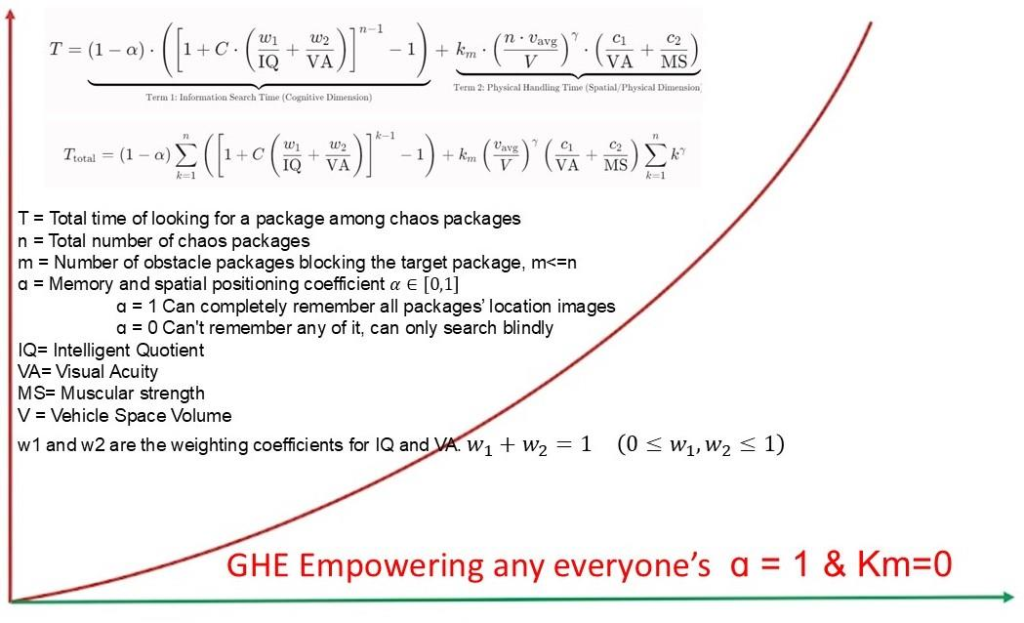
2. The challenge of locating target packages within confined and chaotic spaces.
Fig1: Time of searching a package in the vehicle
3. The High Cost of Locating Target Locations:
Whether its drivers searching for destinations or warehouse workers picking orders and stocking shelves, locating precise targets across various scenarios costs hundreds of billions of dollars annually.
4. What Does GHE Do?
Heart Yang, founder and CTO of GHE, first proposed the “Embrace Information Entropy Increase” model to replace the traditional “Control Information Entropy Increase” model. After repeated debates with
USPTO patent examiners, he obtained several paradigm shift-level patents.
GHE’s revolutionary innovations and patents focus on helping all drivers achieve target parameters of 𝛼 = 1 and 𝐾𝑚 = 0, effectively eliminating all effort spent searching for packages. As a result, search time is reduced to near zero—consistently, regardless of package volume or whether items are organized or disorganized.
Backed by 100+ real-world field tests, GHE’s patented PCD solution introduces a completely new paradigm: embracing information entropy. Instead of forcing meticulous organization before a driver
leaves the station, our smart technology manages the clutter in real time.
By contrast, traditional Last-Mile Delivery (LMD) solutions—including Amazon’s tote system and UPS’s sector model—rely on fighting information entropy. They waste endless time and resources organizing, sorting, and sequencing packages. While these steps are intended to simplify search, they fail to address the problem from a First Principles perspective.
For example, last-mile delivery drivers perform only three actions that truly align with First Principles:
1. Driving to the delivery location
2. Retrieving the package and carrying it to the customer’s doorstep
3. Scanning the barcode and taking a photo as proof of delivery
GHE Package Call Driver Hardware Topology
Fig2: GHE PCD Solution’s Hardware Topology
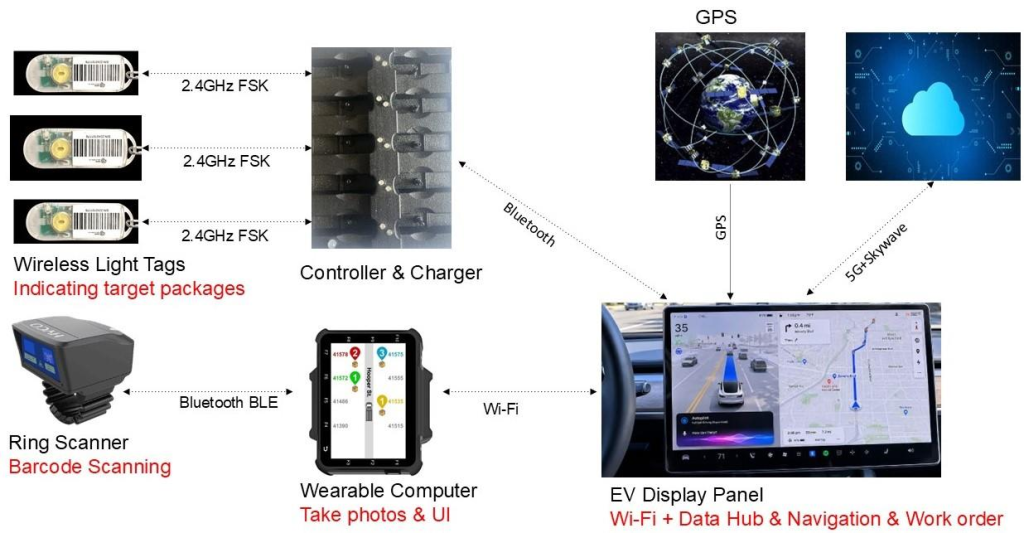
GHE’s PCD solution consists of four hardware components: wireless light tags, a specialized controller and charger, a ring scanner, and a wearable computer, along with an APK embedded with GHE’s
patented PCD algorithm.
Benefits:
1. Random Loading: Load packages randomly into the vehicle at the delivery station with no pre-sorting or FILO required.
2. Auto-Flashing Target Tags: The target package’s tag automatically flashes upon parking, directing the driver to grab it directly—no package searching, no cargo organizing, and no constant app
checking.
3. Ultra-Simple Delivery App: Safe, distraction-free driving.
4. Unmatched Efficiency: 2x efficiency in flat cities, 3x efficiency in mountain cities.
5. Built-in Security: Anti-theft and anti-loss alarm system.
Road Map of GHE wireless light Sticker
Fig3: Wireless Light Sticker

L302 1.2 mm Ultra-Thin Light Sticker
• Eco-Friendly & Wireless: Recyclable and wirelessly rechargeable
• Core Functions: Package Call Sorter & Package Call Driver
• Zero Mistakes: Automatic checkout across all processes
• Triple Efficiency: 3x efficiency across the entire process
• Built-in Security: Anti-theft and anti-loss alert features
• Automated Deployment: Can be automatically applied at delivery stations
• Customizable Performance: Adjustable communication distance and transmission rate
GHE DCD (Destination Call Driver) Solution
Fig4: GHE Smart doorstep plate

Beyond package retrieval, the second-greatest challenge for last-mile delivery (LMD) drivers is locating the destination, particularly at night. In the US, many house numbers are painted dark colors or obscured by overgrown foliage.
The most dangerous and stressful condition for drivers is navigating mountain roads at night during heavy rain—making destination identification an extremely arduous and hazardous task.
GHE’s DCD serves as a guiding light for LMD drivers. It illuminates automatically as an authorized driver approach, enabling them to stop quickly, safely, and accurately at their destination.
5. Key Scenarios for a Trillion-Dollar Market: Embracing Increasing Information Entropy
1. Last Mile Delivery(LMD)
Traditional last-mile delivery (LMD) accounts for 50% of total package delivery costs, with drivers spending more than 50% of their time simply searching for packages inside the vehicle. Figure 5 illustrates this driver time distribution. If a new paradigm can completely eliminate package search time, overall logistics costs will drop by 30% to 40%, while delivery speed will increase by more than 200%
Fig5
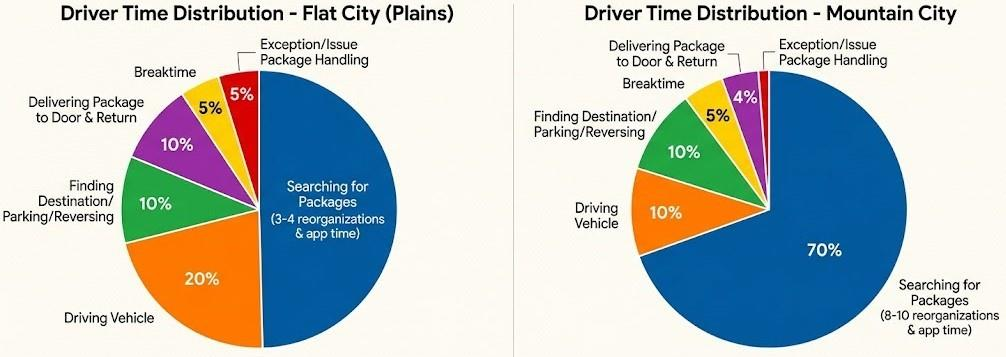
Beyond the time lost searching for packages, manual errors represent another major challenge, often leading to customer claims
2. Manufacturing
Shipping warehouse
Assembly-Line-Side warehouse
Material warehouse
3. Supermarkets and stores
Loading to shelf
O2O Order Picking
4. Fulfillment Warehouse of e-commerce
Order picking
Order sorting
6. Summary
Every year, trillions of dollars are wasted combating rising information entropy. Once industries shift to the new paradigm of “embracing rising information entropy” instead of the traditional paradigm of “controlling information entropy,” it will inevitably drive a resurgence and explosive growth across the North American and European real economies.
Our 100+ real-world field tests demonstrate a 2x efficiency gain for drivers in flatland cities and a 3x increase in mountainous areas—a revolutionary performance leap that traditional entropy-control models simply cannot match.
Keep reading
Download the PDF version
Please fill in your information to download. Fields marked * are required.


Copyright @ GHE SOLUTION INC. All Rights Reserved