

< Research Reports 22 Oct, 2026
Innovative index of Smart Last Mile Delivery?
Abstract:
After more than 200 on-site tests of the last mile delivery, we found more than 50% of the time wasted for unnecessary operations. And we found most innovative solutions are in the wrong direction. Then we define the innovation index, hoping to help the industry decision makers have a scientific and rapid evaluation method for last mile delivery innovations.
Key words:
Last mile delivery, innovation index, standard, decision makers.
Content:
Why do we need a standard for Last Mile Delivery innovation?
The last mile delivery cost occupies more than 50% of the logistic cost of e-commerce, the innovation level for last mile delivery will affect e-commerce significantly in future. So, we need to unify a standard to evaluate the innovation level for last mile delivery. And the standard can benefit to:
1.To indicate the correct roadmap of revolutionary solutions for Last Mile Delivery industry
2. Help decision maker Reduce interference from many uneventful even useless solutions
The valuable operations of Last-Mile Delivery driver are:
1. Load of packages from delivery station
2. Drive to customers’ destination, maybe replaced by fully autonomous driving in future
3. Grab packages in the vehicle and deliver them to the customer assigned place
That’s all! If all drivers can retrieval the target packages very simply and quickly, all other operations are unnecessary, including operations such as frequently checking the work phone or PDA, opening the totes, sorting and organization, reorganizing while driving, write a big number, and multi-roundtrips are all unnecessary.
The following is a list of unnecessary operations of traditional delivery:
For Amazon like totes constraint delivery mode, all below operations blamed to retrieving packages:
1. Find the package in the vehicle after each stop.
2. Check the delivery phone to find the packages’ information.
3. Manually search for the next stop to avoid round trip (optional for some drivers)
4. Open bags and organize packages in order.
5. Fold bags and return them to the delivery station.
6. The round-trip time caused by packages of the same or adjacent addresses
being loaded with different bags
7. The round-trip time caused by not finding the package on time.
Based on our on-site more than 100 tests on different drivers and different types of vehicles and across four seasons, The above operations waste more than 50% of the delivery of drivers’ whole delivery shift.
Then double efficiency only needs to Eliminate the above unnecessary operations.
Then double efficiency only needs to Eliminate the above unnecessary operations
For UPS like whole vehicle delivery method, all bellow time and actions blamed to retrieving packages:
1. Find the package in the vehicle after each stop.
2. At least 2-3 times organize the packages daily, waste 1.5 hours if 200 packages. And drivers must look for somewhere that can stop for a long time and pause delivery.
3. Checking PDA to find the packages’ information.
4. The multi-round trip time caused by not finding the package in time.
Based on our on-site more than 100 tests on different drivers and different types of vehicles and across four seasons, The above operations waste more than 50% of the whole delivery shift.
Then double efficiency only needs to Eliminate the above unnecessary operations.
How to test the time wasted? The test method is simple and easy, and everyone can repeat the test. You only need to use the mobile phone to accumulate the time for the above effective actions. Although it is simple, the research and analysis work are also very hard and very boring.
Index for smart Last Mile Delivery innovation solutions
Ip = Iv + Ic + Ie + Ii
Ip means Index of perfectly of total innovation solutions
Iv means Index of Valuable Ratio
Ic means Index of low carbon contribution ratio
Ie means Index of innovation solution extendible capability
Ii means Index of return on investment
All above index, the bigger the better.
The standard should exclude the interference of complex road conditions, such as traffic jams, because I count the behavior of driving to the customer as value behavior. The traditional solution and the innovative solution can be only compared under the same road conditions, that is, the innovative solution in poor road conditions cannot be compared with the traditional solution in good road conditions.
Of course, the standard should exclude the interference of quantity of packages and stops, meaning that all the testing conditions are the same.
Iv Index of Valuable Ratio
Iv Used to evaluate whether innovative solutions can eliminate unnecessary operations as much as possible
Iv= Total time of valuable operations / Total time of the whole delivery shift
Total time of valuable operations include below operations’ time.
1. Time spent on load of packages from delivery station
2. Cumulative time spent on driving to all customers’ destinations,
3. Cumulative time spent on Grab packages in the vehicle and deliver them to the customer assigned place.
How to get the total time of valuable operations? An engineer or management can use a mobile phone’s timer to statistic and analysis it, it is really a hard work. The total time of the whole delivery shift is very easy to get through, from the start of delivery to end of delivery.
Iv<=50%, typical traditional solution
50%< Iv<=70%, optimized traditional solution
70%< Iv<=80%, Nice innovative solution
80%< Iv<=90%, Excellent innovative solutions
90%< Iv<95%, Outstanding innovative solutions
Iv>=95%, Perfect innovative solution
Ic Index of low carbon contribution ratio
Ic Used to evaluate the innovative solutions contribution to low carbon and environment friendly,The average carbon emissions should include the total carbon emissions of fuel, auxiliary materials and equipment such as stickers and labels, totes, etc., averaged over each package.
Ic= Average carbon emissions per package of existing solution / Average carbon emissions per package of innovative solution
Ie Index of innovation solution extendible capability
Ie Used to evaluate the extendible capability of innovative solution, we can assume the daily maximum packages will up to 1000 for each vehicle in future. No matter the size of the vehicle and packages. Currently the daily average delivery capability is only 200-250 packages for different delivery methods. If the revolutionary innovation solution can support 1000 packages, it will accelerate the development and efficiency of all express delivery related industries.
Ie= The quantity of packages per vehicle that the innovative solution can support / 1000
Ii means Index of return on investment
We believe that the return on investment time is more appropriate within 1 year,of course, The shorter the return on investment of innovative solutions, the better. then we define
Ii = 12 / Actual payback time of innovative solutions (months)
Basic standard for Last mile delivery innovations.
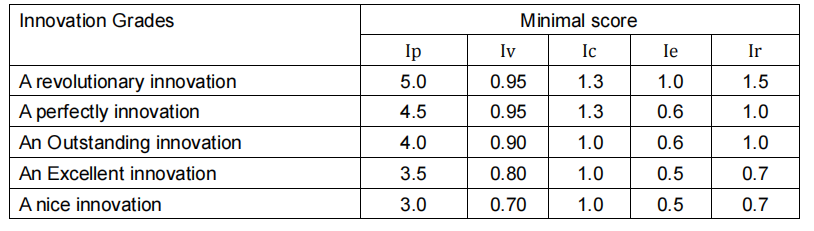
After defining all index terms and their calculation method, then we can unify the innovation levels for last mile delivery as following table.
Summarize
With the data-based and standardized Last Mile Delivery innovation evaluation method, we can guide the future innovation direction and provide a quick selection standard for innovation solutions. And can avoid directional errors in decision-making and huge waste of practical application.
Keep reading
Download the PDF version
Please fill in your information to download. Fields marked * are required.


Copyright @ GHE SOLUTION INC. All Rights Reserved