


About GHE
GHE Solution empowers last-mile delivery so everyone can enjoy same-day delivery every day.
Delivery service prices in the US and Europe are too expensive, service speeds are too slow, and the loss rate is high. The US now handles 64 million packages daily, while Europe manages just 51 million, both far less than China's 466 million.
Why is there such a large gap?
The reason for this gap is that China's package delivery services are fast and affordable. China has an 80% same-day delivery ratio at a very low cost. Whereas in the US, the same-day delivery ratio is less than 4.5% and very expensive. To improve its same-day delivery ratio, the US needs a paradigm shift, with innovations that optimize the speed and reduce the cost of express delivery.
Empowering same-day delivery service providers with the right tools will increase their market share. With increased market share, same-day delivery service providers will meet the demand of a larger market. For example, at a market share of 10 times the current size, same-day delivery service providers will significantly influence the growth of physical businesses. The industries most impacted by this include e-commerce, food and beverage, manufacturing, and transportation. Cheaper, safer, same-day delivery is the future of package services in the US.
Why GHE?
ϕ-shaped talent who has read over 1,500 books on the Social Sciences.
Pioneer of the Embracing Entropy Increase model.
Rich on-site experience across all LMD roles in the US.
Top 10 Supply Chain Innovators in China, 2013.
Chief consultant for the top three express companies in China.
Ultra-Low Power IoT innovator.
Conversations with more than 1,000 workers, including CEOs.


GHE Approaches
Based on the first principles of last-mile delivery and rich on-site experience across all roles, along with surveys and discussions with over 1000 individuals ranging from workers to CEOs, we identified the real pain points and problems with the existing solutions.
We abandoned fixed mindsets and learned helplessness while also addressing technical challenges.
We are the first company in the world to propose a paradigm shift toward embracing entropy increase, eliminating the large amount of unnecessary redundancy and auxiliary operations caused by traditional solutions or entropy-increase control models. We retain only the minimal operations that conform to the first principles of last-mile delivery.
We empower workers so they can work more safely and easily while also greatly increasing their productivity, instead of replacing them with costly, high-carbon-emission automation systems and robots. No work, no consumption; no US GDP.
The Status of Same-day Delivery Service Providers and the GHE Breakthrough
No standardization process
Currently, four major companies dominate the US market, controlling 97% of express delivery services. Meanwhile, hundreds of smaller same-day delivery providers operate across the country, holding less than 3% of the market share. The small same-day delivery providers cannot innovate and, for decades, have kept the same outdated processes and management. What should be a standardized same-day delivery service has been turned into a contract logistics model by many same-day delivery service providers. Moreover, almost all operations depend on workers' working memory, and some positions can only be handled by an elderly person. That is the main reason why they have scaled up very slowly over the past decades.


Relying on Working Memory and Multi-Sorting
For decades, all processes have depended on workers' working memory. Some jobs can only be done by a single elderly worker in certain warehouses, many of whom are already approaching retirement age. When they can no longer perform these tasks, can the business continue?
Why Multiple sorting?
Because human memory and information retrieval capabilities are highly limited, multiple sorting processes are required before packages are assigned to specific drivers. Each manual sorting step can only categorize packages into 4-5 zones. For example, a warehouse with 50-60 drivers needs three-step sorting. What would happen if the business expands to more than 200 drivers? That would require four-step sorting. This not only wastes a lot of time and energy and delays delivery, but also increases the risk of lost, damaged, or delayed packages, all due to multiple sorting steps.
Driver loads packages from zones
Drivers need to go to multiple zones to find and scan packages. At the beginning of the driver’s work period, 30-60 minutes are wasted on finding packages, scanning, keying in, and then loading them onto the vehicle. This not only wastes time but also consumes a lot of physical and mental energy from the start, weakening their concentration during delivery. This leads drivers to speed up to save time, which, in turn, causes unsafe driving and increases safety risks.

GHE Breakthrough for Same-Day Delivery Service
Benefits of the GHE Solution for Same-Day Delivery Service Providers

Uniform Standard Process
Easy to serve more customers

Relax Brains
Hands-Free

Combine 3-4 steps of sorting into a single 1-step process
3X-4X efficiency and reducing 95% of mistakes and accidental damage

Reduce operating costs by 70%
Reduce the loss rate by 95%

Much easier to recruit new workers
Simplifies management processes

Empowers American Dynamism
Benefits all stakeholders
Lower cost and safer same-day delivery are fundamental needs for all customers and are essential for revitalizing American manufacturing. Achieving this will require a revolutionary new paradigm.

GHE Practical New Paradigm for Same-Day Delivery Providers
1. Uniform Standardized Process

Standardized Process for Different Customers.
Simplest sorting method for all package types.
Sort packages directly into each driver’s container in a single step.
Driver only needs to pick up packages from one container within 3-5 minutes every day.
Sorters only need to scan the barcode; they don't need to read the addresses on the delivery label.
Sorters don’t need to remember all of the target destinations and containers' codes.
Sorters only need to scan the package barcodes and then place it into the container that flashes its assigned color. This process increases efficiency and simplifies the operation.
Simplify management.
The container is a standard smart container transformed by an RGB wireless light tag.
Containers can come in all kinds of shapes, including wooden boxes, cardboard boxes, and pallets.
2. 1 Step Sorting

Powered by our smart container concept, packages only need to be sorted once. No matter how many packages need to be delivered, sorters can organize them for up to 255 drivers in just three steps. This reduces the number of times packages are thrown or dropped, which lowers the risk of damage, loss, and delays.
Sorters only need to scan the package barcode, locate the container flashing the assigned color, and place the package into that container. That’s the whole process; it’s very simple and efficient.
The container is a standard smart container transformed by an RGB wireless light tag. Each container’s wireless light tag can flash 7 colors, meaning up to 7 sorters can work together at the same time. Containers can come in all shapes, sizes, and materials, including wooden boxes, cardboard boxes, and pallets.
3. Reduced Mental Effort

Wireless light tags call sorters, meaning workers no longer need to remember the thousands of customer addresses and their corresponding containers. Sorters only need to scan the package, see which target container's wireless light tag is flashing, and then drop the package into that container. It’s so simple to operate that new workers can start working after just 10 minutes of training, and their efficiency is much higher than that of experienced employees working with the traditional solutions.
4. Hands-free

Ring Scanner
Wearable Computer
Waist-mounted label printer
All wearable devices are completely hands-free
5. 3 Minute Package Loading Process

Drivers no longer need to search for their packages in multiple zones.
Drivers pick up packages from a single smart container, which takes only 3-5 minutes.
Drivers no longer need to scan each package's barcode; they only need to scan the container barcode, which links to all of the packages on a specific driver’s route.
6. Drivers No Longer Need to Key In

When a package sorter encounters an unreadable barcode, they place it in an exception-handling container. A designated worker will then use a wearable computer to key in the barcode numbers. A portable label printer will take the barcode information and print a new sticker with a clear barcode. After printing, the label will be applied to the package and returned to the sorting area for re-sorting. This avoids having each sorter key in faulty barcodes and reduces steps for drivers further along the delivery process.
Major Players' Status, Pain Points, and GHE Breakthrough
The main issue with the major last-mile delivery players is that they use traditional delivery methods designed to control entropy increase, but these methods are becoming less effective as the number of packages per vehicle continues to grow.
The traditional delivery method or entropy control model wastes a lot of time and energy, resulting in high costs and slow delivery speeds.
A paradigm shift to a model that embraces entropy increase is needed to save time, energy, and costs. It is also needed to meet the increasing demand for package delivery services.
Pain Points of Delivery Drivers

Delivery drivers face a high risk of injury and often work long hours,
sometimes returning home past 11:00 p.m.
The current conditions for delivery drivers are unsafe as well as mentally and physically demanding because the traditional delivery method involves several auxiliary steps designed to speed up the process of locating packages.
Examples of these auxiliary tasks include:
● Organize packages multiple times per shift.
● Frequently checking the mobile work phone.
● Handwriting large numbers to help identify packages.
Many operations are also needed due to the difficulty in finding packages, such as:
● Multi-round trips.
● Open, recycle, and return bags.
● Difficulty locating destinations, especially in mountainous areas at night.
Pain Points of Preloaders

Waking up earlier than a rooster is bad for workers’ health. Staring at the assembly line looking for packages makes workers dizzy.
Many operations are designed to make it easier for drivers to find packages.
Those operations occupy more than 75% of the time spent working a shift, such as:
● Finding specific sections inside a dimly lit vehicle.
● Repeatedly organizing packages to keep them in order across all sections.
● Handwriting large numbers or similarly facing package stickers towards the aisle.
● Lifting heavy packages to the top shelf and organizing them.
● Collect overflow packages from the end of the assembly line that were not sorted in time.
● Etc.
Each big player logistics company reports tens of thousands of injuries annually.
GHE Breakthrough for Pre-loaders

Our new paradigm of embracing entropy increase allows delivery drivers to find packages in seconds.
This mode increases the value of preloader operations because preloaders can load vehicles randomly,
so drivers no longer need to reorganize them. Preloaders will no longer do the following tasks:
● Load packages into assigned sections.
● Organize packages in order.
● Handwrite large numbers for each package.
● Lift heavy packages to the top shelves.
Then all Preloaders can:
Wake up after sunrise, which has beneficial impacts on their health.
They’ll also see significantly lower injury rates because packages are loaded randomly,
reducing the physical effort required to organize them into vehicles.
Preloaders’ per-package operations are reduced to only 3 steps, compared to the traditional solutions, which require at least 11 steps per package.
The 3 steps for each package pre-loading are as follows:
① Locate the package on the sorting assembly line.
② Place the package anywhere inside the correct vehicle.
③ Bind a wireless light tag to the package.
GHE Breakthrough for drivers

Photos of our on-site testing.
After binding a wireless light tag to a package, preloaders turn the traditional package into a smart package.
The smart package automatically indicates its location to the driver by flashing and beeping.
This occurs once the driver has arrived at the delivery destination.
Drivers no longer need to find or organize packages,
Drivers don’t need to lay out rows of delivery packages
Drivers do not need to write big numbers packages.
Injuries caused by falling packages no longer occurs.
The wearable computer has the highest GPS sensitivity available built into the device. It can detect GPS coordinates in real time. This eliminates multi-round trips to the same address.
The HUD-like function of wearable computers is hands-free, and can reduce distracted driving.
Drivers’ operations for each package are reduced to only 4 from traditional solutions’ 17.
These 4 steps include:
① Drive to the destination
② Grab packages directly
③ Delivery to customers’ doorstep
④ Scan and take a photo
Products and Technologies

Wireless Light Tag
The unique advantages of GHE’s global leading wireless light tag are:
* Dedicated design for same-day delivery sorters and last-mile delivery drivers
* Ultra-Low power consumption, up to 10-12 months for repeat use, and can be charged
* After fully charged, it can be used another 10-12 months
* 7 colors indicator, easy controlled by phones or wearable computer
* Flash and beeper to indicate drivers
* Anti-theft and anti-lost alarm
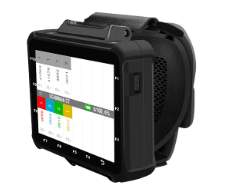
Wearable Computer
The unique advantages of our wearable computer:
* Built-in is the highest GPS sensitivity available, dedicated to optimizing for delivery drivers
* Built-in camera that can scan barcodes and take photos
* 10 user-friendly short keys
* Built-in G-Sensor for action detection
* WIFI + Bluetooth compatible

Controller & Charger
The key functions and performance of our controller and charger:
Each unit can connect to 2,048 wireless light tags with a 1-second response time
Maximum co-existence is 512 controllers. That means we can support a maximum of 512 vehicles being preloaded simultaneously
This is also our unique advantage: a patented communication protocol, because existing wireless communication protocols cannot support up to 512 host devices coexisting in one area
The built-in battery can support 12 hours of communication
Remote upgrade functions
Response time: < 1s

Ring Scanner
Advantages:
* 20g weight
* 50 meters Bluetooth connection
* 30KV ESD Protection
* The best EMC design
* 5% power consumption of traditional scanner
* 3 meters drop-resistant and IP66
* 18 hours of continuous working
* Both side touch key
News & Stories
Beyond the Scaling Law: A Critique of Brute-Force Computation in Physical-World AI and the Necessity of Closed-Loop Synthesis
Current developments in Artificial Intelligence are dominated by the "Scaling Law" paradigm, which posits that increasing computational power and dataset size leads to emergent intelligence. While successful in digital linguistics, this open-loop, brute-force approach encounters a "Dimensionality Curse" when applied to high-precision physical interactions. This paper argues that purely stochastic models cannot resolve infinite-dimensional analog disturbances, such as environmental vibrations or micro-turbulences, due to inherent latency and lack of causal grounding. We propose a synergistic framework that integrates heuristic "Brain" cognition (Big Data) with deterministic "Cerebellar" execution (Closed-Loop Control). We demonstrate that a hardware-accelerated, low-power MCU-based feedback system in analog domain outperforms massive GPU/TPU clusters in ensuring physical-world certainty. This method can save 100 million times the computational power required.

The Paradigm Shift: Why Every Physical Industry Must Stop Fighting Entropy.
At GHE Solution, we believe the primary obstacle to economic growth is the cost of managing Information Entropy, defined as the rate at which a system’s disorder renders its data unreliable. The faster the disorder, the more time, energy, and human cognitive capacity that gets wasted by traditional “Entropy Control” methods (i.e., manual scanning, mental […]
The Tragic Truth: Logistics’ Biggest Cost Is Fighting CHAOS.
For decades, the economy, from manufacturing to last-mile delivery, has been bleeding cash in a losing battle against Entropy. We are spending trillions of dollars not to transport goods but to maintain order (to fight entropy) so that people can find what they need. The limitation of the traditional logistics model is that it imposes “ordered […]
The Circulatory Crisis: Why America Must Transcend the Information Entropy of Legacy Logistics
Information Entropy, Macro-Logistics, IoT, Supply Chain Resiliency, Human-Centric Innovation
The Entropy-Driven Economy: Americans Waste Trillions Fighting Chaos
In the United States, end-to-end logistics is burdened by several inefficiencies, including complex operations, a high package-loss rate, and rising costs. Together, these three issues pose a big obstacle to economic growth in the American supply chain. To understand the impact of these inefficiencies, GHE Solution gathered firsthand insights from frontline logistics workers. Employee experiences […]
How the GHE Solution Optimizes Pre-Loader WorkFlows
The pre-loader job requires workers to wake up at 2-3 o’clock in the morning. This goes against natural human health. At GHE Solution, we believe an optimal start time for pre-loaders is at 7 a.m., not 3 to 4 a.m. Currently, the two main risks for pre-loaders are spending too much time inside the vehicle […]


Copyright @ GHE SOLUTION INC. All Rights Reserved